
CRIME TIME: Oct 4 - Oct 10
Armed suspects on Ardmore, a BB gun on the Pier Plaza and two hill-section burglaries top this week’s police log.
A petition with 340 signatures and a ticking federal clock: the Planning Commission sent T-Mobile back to the drawing board over its proposed PCH rooftop antennas in a search for compromise on cell tower plan

Facing a room full of opposed neighbors and a federal clock that leaves little time to spare, the Hermosa Beach Planning Commission on Tuesday night declined to approve a proposed T-Mobile rooftop wireless facility at 2447 Pacific Coast Highway, instead sending the carrier back to redesign the project and return for a special meeting on August 4.
It is the second time this year the Commission has pumped the brakes on a carrier's rooftop application amid neighborhood opposition. In March, commissioners continued a Verizon facility proposed for 725 5th Street and directed the company to explore moving its antennas away from adjacent homes; Verizon has since decided to look for alternate locations, in a perceived win for those neighbors.
The application would place three screened antenna sectors — four panel antennas apiece — on the facade of the multi-tenant commercial building at the southwest corner of PCH and 24th Place, plus a 152.5-square-foot equipment area on the roof. The building has hosted wireless equipment since 2001, and an AT&T facade-mounted facility was approved in 2019. City code gives preference to co-locating new facilities on existing sites.
City planning staff recommended approval, finding the project consistent with the municipal code and categorically exempt from review under the California Environmental Quality Act (CEQA) as a small addition to an existing structure. The screened antennas would top out at 30 feet 10 inches, below both the existing parapet and the zone's 35-foot height limit.
T-Mobile's representative told the Commission the new site is needed because the carrier is losing an existing facility atop the Skechers building a few doors away, where the lease expired earlier this year. "We did try to pick the best location, least intrusive," he said, adding that the area's topography — the land drops away to the west — and the limited stock of commercial buildings along PCH left few workable alternatives.
That explanation did not satisfy the ten residents — most of them from 24th Place or its immediate vicinity — who testified against the project in person and online. Speakers said a neighborhood petition opposing the installation had gathered more than 340 signatures.
Julie Hofer, who lives directly across the street at 743 24th Place and works as an auditor for the Department of Energy at Los Alamos National Laboratory, said the radio-frequency exposure studies supporting the CEQA exemption were "fundamentally flawed" because they excluded her building — a 10-unit complex at the same four-story elevation as the antennas, one of which would point toward her bedroom window. "I know that if inputs are flawed, the conclusions are invalid," she said.
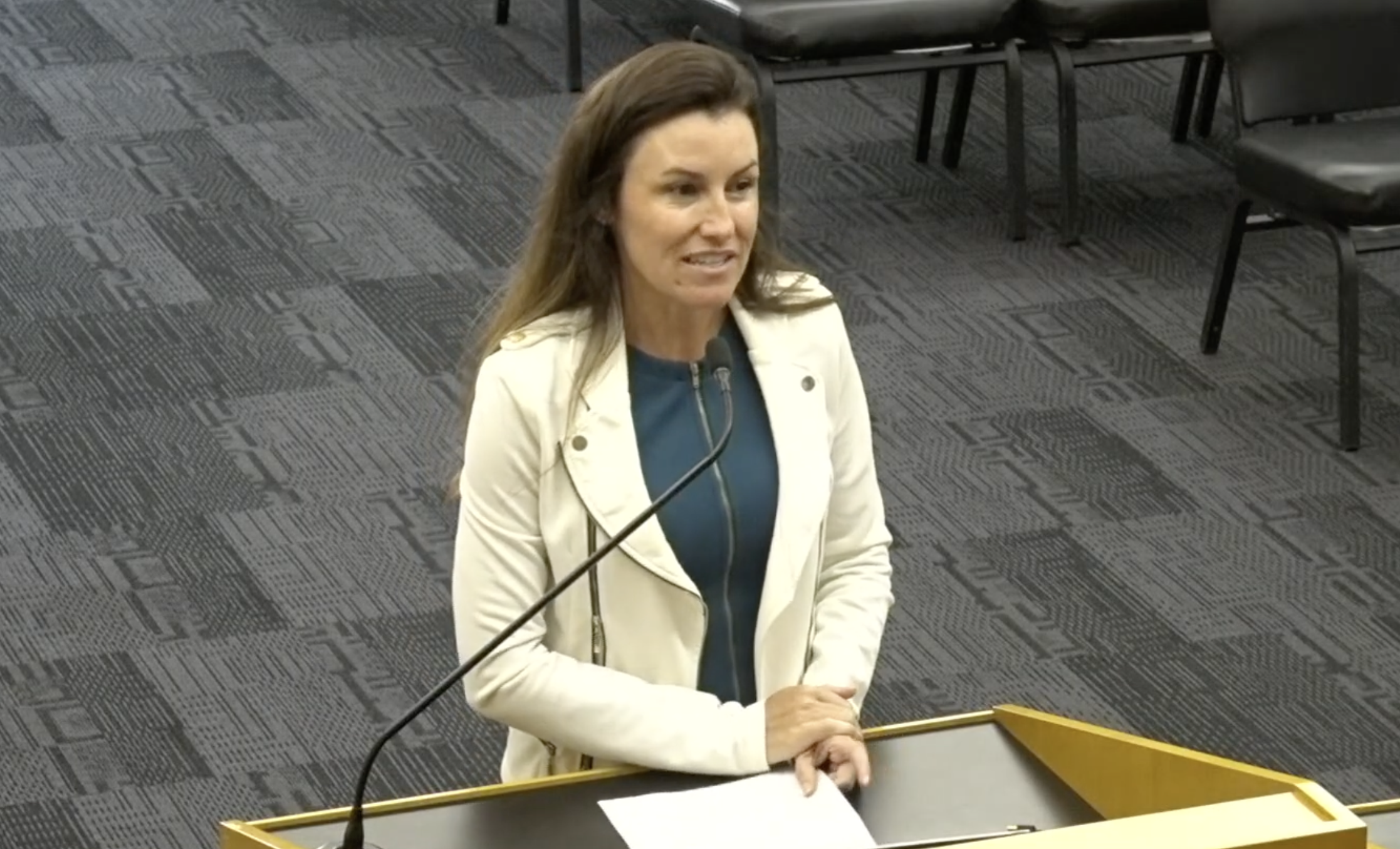
Her neighbor Chris Matzik added a concern echoed by several speakers: property values. "The homeowner was here first, not the telecom operator," he said.
Leslie Button cited T-Mobile's own gap-coverage report, which she said shows the replacement site would produce a net loss of residential in-building connections — about 119 lost against 110 commercial connections gained. "This is not fixing a critical unserved community crisis. It's a lateral move for corporate convenience," she said.
Jessica, who lives about four and a half feet from the proposed equipment at 740 24th Place and is expecting her first child in a few months, asked the question at the heart of much of the testimony: "If there's no meaningful coverage problem to solve, why should families bear the burden of the impacts?"
Jason Wallace, a 24th Place resident of some 40 years, zeroed in on the city's wireless ordinance, which requires a finding that a proposed site "results in fewer or less severe environmental impacts than any feasible alternative site." The applicant, he argued, had never documented a real alternatives analysis. Patricia Zingheim, who owns the commercial building immediately south, objected that the emissions report ignored the combined effect of the T-Mobile and AT&T equipment, and said that approval of the project would jeopardize her plans for a legal rooftop deck.
Commissioners repeatedly reminded the audience that federal law ties their hands on the issue underlying much of the opposition. The Telecommunications Act of 1996 bars local governments from denying a wireless facility over radio-frequency emissions if it complies with FCC exposure limits, and any denial must be supported by substantial evidence in the written record.
The Commission also faces a federal "shot clock." As a co-location application, the project must be decided within 90 days of a complete application — and Tuesday was day 69. Staff cautioned that running out the clock would result in the application being deemed approved.
Still, the hearing produced movement. Pressed by commissioners, T-Mobile's representative agreed the two sectors proposed for the north and south sides of the building — those closest to homes on 24th Place — could be relocated toward the center of the east face along PCH, behind an architectural feature that would be raised several feet, possibly above the zoning height limit. The company also offered a revised emissions report covering both carriers' equipment, measured near the most affected neighboring buildings, along with post-installation readings.
Commissioners eventually voted to continue the hearing so the applicant can redesign: relocating whatever antennas can be moved, particularly away from the west side facing the neighborhood, and strengthening the permit condition that lets the community development director demand periodic compliance testing.
Because the shot clock requires action sooner than the next regular meeting, the item was continued to a special meeting on Tuesday, August 4, at 4:30 p.m. The vote was unanimous.
"I do want to give note to the applicant for listening to public comment, listening to our discussion, and their willingness to find a solution," Commissioner Greg McNally said before the vote. "I'm hopeful that we can find this solution."
KEEP READING
 Hermosa Review

Hermosa Beach’s current labor contracts lock in raises through June 2028, protect senior staff from layoffs, and pay one group bonuses for meeting just one goal in five. Police pay alone rises about 18%, while the city’s own forecast shows deficits of $3.8 million to $5.6 million ahead.

Appeals court reaches verdict in long-running case over former HbPD officer Jonathan Cruz's dismissal after refusing the COVID-19 vaccine during the pandemic.

Third and final City Council Candidate debate promised fireworks with 'challenge card' system. The format ultimately delivered more consensus than disagreement.

Election season moves into full swing with the first candidate debate last night.
By Hermosa, for Hermosa. Join The Review today.