
Hermosa Beach's Q2 Serious Crime Stayed Flat Versus Last Year
Second quarter serious crime stayed flat year over year, but cases of assault rose sharply. General trends remain downwards year-to-date.
Ninety-one years after the first tournament on the Clark Complex green, Hermosa Beach asked whether it should still be there. The bowlers packed the chamber last night to give their opinion.

The city chamber was full an hour before the volleyball players needed it.
They had come for a question the City Council put to the Parks and Recreation Advisory Commission on Tuesday night: whether a bowling green Hermosa Beach has maintained since 1935 still deserves the land it sits on, or whether the city should be looking at something else.
The item arrived by way of two Council actions. In June 2025, Councilmember Raymond Jackson initiated an action that directed staff to prepare a report on the Hermosa Beach Lawn Bowling Club's operations, membership, maintenance and legal standing. On July 28 of this year, Council approved an agreement with the club for a one-year term that then continues month to month, and asked this Commission for feedback on the facility's future.
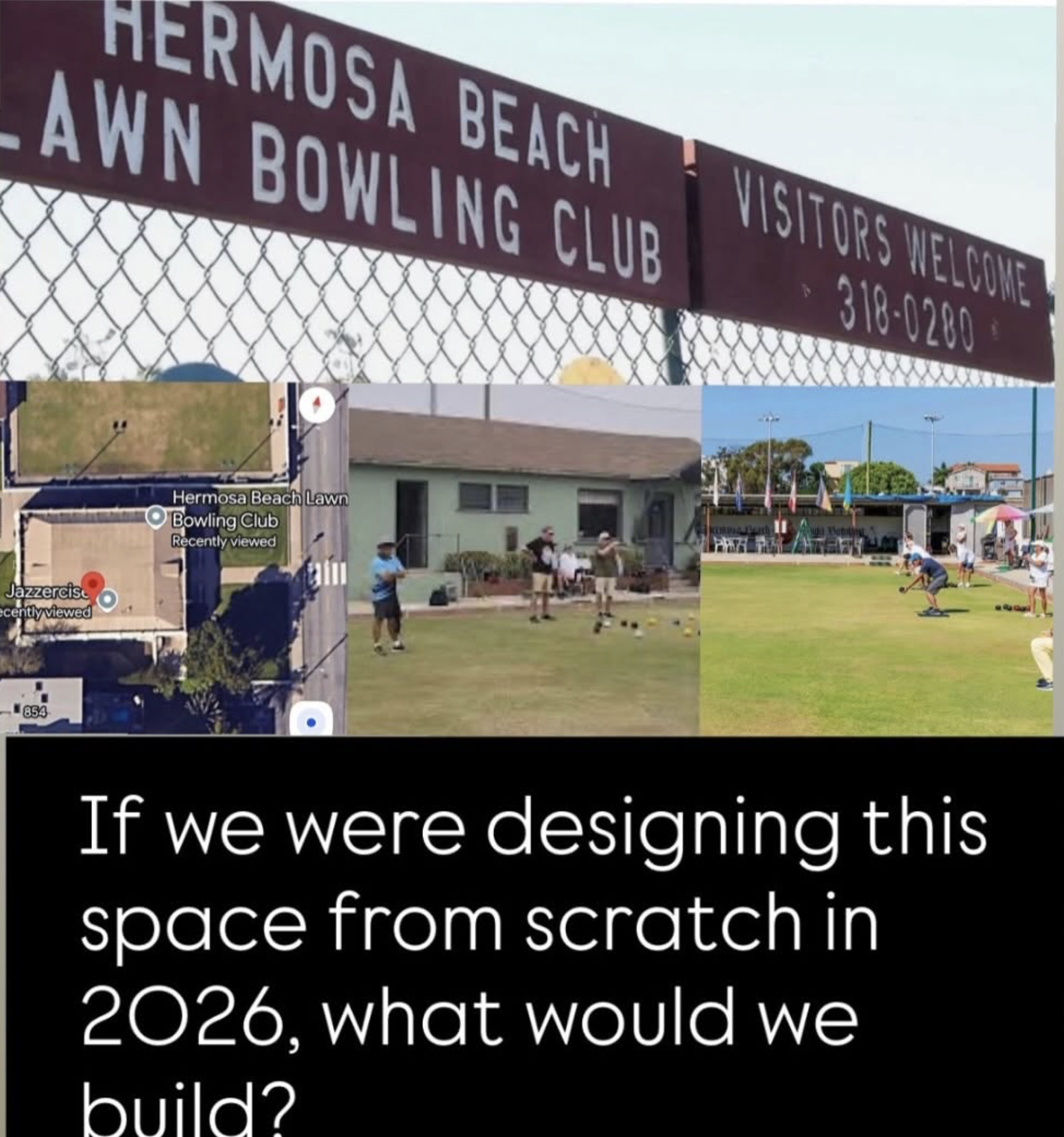
Staff laid out four questions. Does the current use still serve the community? Should the club's operations or maintenance responsibilities change? Could public access be expanded? And should alternative uses be explored, either alongside lawn bowling or in place of it.
Staff recommended nothing. "Staff is not recommending a specific future use or repurposing plan at this time," the presentation noted. The point was to collect the Commission's view for Council.
The lawn bowlers' clubhouse is in urgent need of repair. City staff have previously cited concerns over liability in the event of an accident, and the potential cost of those repairs has come at a time when the city wrestles a looming budget crisis.
The issue has crystallized rather suddenly. It was not raised as part of previous City Manager Suja Lowenthal's Civic Facilities Project Advisory Group, which focused on a potential replacement of City Hall, Community Center and City Yard. It was not raised by the City's Finance Sub-Committee which included Councilmembers Raymond Jackson and Mike Detoy. But the lawn bowlers know now that they are potentially in the crosshairs, and they came to plead their case.
The city bought the land that became the Clark Complex in 1933 for park and recreation use. It was later named for former Mayor John Clark, who advocated for the park and put his own money toward installing the green. The first tournament was held in 1935.
Karen Shore, a 23-year Hermosa resident and three-year member, spoke for the club and had come prepared with a statement.
She described a sport that survives what other sports stop allowing. "The great thing about lawn bowling is that almost any person, in spite of any certain physical limitations, can play," she said. "Our social bowls gathering pit young against old, male against female, newbie against pro. Anything can happen on any given day." Club members include people who have bowled their way back from a stroke, and a woman who had polio as a child, for whom lawn bowling was the first sport she was ever able to play.
The competitive side is real. Inger Benson, a Hermosa Beach resident who was in the chamber, finished third in singles at the 2024 USA National Championships in Milwaukee and will compete in women's pairs at this September's Bowls USA national playdowns. The club hosts the Allcomers Tournament over Labor Day weekend; last year it drew 56 of the top bowlers in the country.
Charles Moffitt, an officer of the Southwest Division of Bowls USA, said he had been asked by the club to come. He is 84, took swimming lessons at the Hermosa Biltmore as a small boy, started surfing the coast in 1954, and once worked at Jacob's Surf Shop where Hermosa Avenue turns into Manhattan.
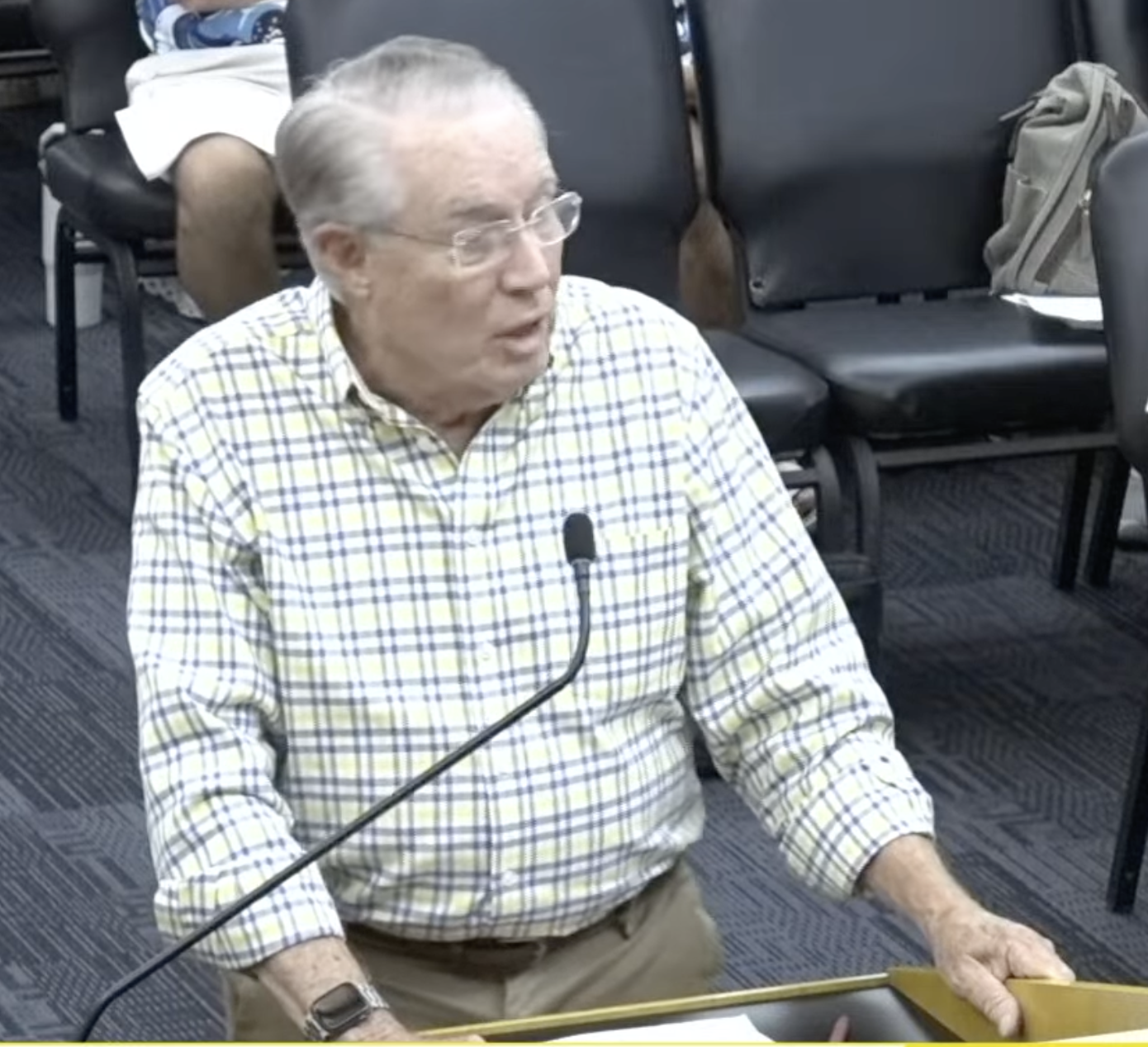
His division has 2,000 members across 26 clubs from the Mexican border to San Luis Obispo. The oldest is 116 years old. Most are 90. Eighty-five percent of lawn bowlers in California, he said, are 65 or older.
Then he explained why he had actually come. His wife discovered the sport five or six years ago. She had brain cancer when she was younger and lost the sight in her right eye. She has two replacement knees, a replacement hip, and a heart condition that has to be watched.
"She is a lean, mean bowling machine," he said. She bowls three days a week, still works as an architect at 73, and "bowling has just given her this tremendous spirit. I met her at the age of 24, and she's 24 all over again."
He closed on something he said he learned as a deputy mayor of Los Angeles working with that city's Rec and Parks Commission. "The measure of the success of a recreation program is not only how many people participate, but the effect that it has on their lives," he said. "Swimming lessons for a young person are life-changing, and active recreational programs for older adults can be life-saving."
Commissioner Elka Worner went first and did not hedge.
"This facility has been here for 90 years. There's very few things that we have in this town that have lasted this long and have been used for this purpose for that long," she said. "I remember when I was a kid walking by there, and I still walk by there and I see the flags and the lawn bowlers, and it's just a tradition, and it's really an asset to our community."
She had gone to the open house about a year ago. "You were just the friendliest group of people. Everyone said hi. You have music on. You're lawn bowling with no shoes on, barefoot lawn bowlers." She met people in their twenties who told her it had become a retro thing to do. She talked to two women whose husbands had died, "and they said if it weren't for this, we'd be at home watching TV."
Vice Chair Todd Tullis agreed the use is worth continuing, with a condition: "as long as the club continues to be sustainable, given its obligations to the city." He suggested the green might also host things that do not damage it, senior tai chi or yoga, cornhole, croquet.
Commissioner Tom Moroney was the one who took Council's repurposing question seriously enough to answer it out loud. He ran through the alternatives that exist: the dog park advocates want space, and a group has wanted a municipal pool for decades, though he doubts the site is big enough and thinks staff should say so.
"I'm not convinced that any of them is better than what we are doing there," he concluded. "The activity that belongs there is the activity that's there."
His caveat was about visibility. "The more Hermosa residents you have in your club, the more successful you're going to be, and the more justifiable it is to the city to set aside a large area of our parkland for one activity." He proposed the club present to the Commission annually, the way long-term agreement holders do.
Commissioner Barbara Ellman turned that into a general rule, and aimed part of it at the Commission itself.
"I think it was on us and it was on you. We failed at doing our job, which is to constantly understand what is going on," she said. Every group using city space should be appearing before the Commission to report what is working and what is not. She also defended Council's right to have asked the question in the first place.
"This is what happens when someone such as a council member makes a comment and then everyone gets their knickers in a knot, because it's like a forbidden word to question what it is we've been doing for 10, 20, 30, 40, 50 years," Ellman said. "If we don't look at other options, we won't know. Please don't get upset when someone wants to talk and question what we're doing in this town, why we're doing it, and how we can do it better."
Chair Tracy Horowitz landed on the practical version. There is "an undercurrent of conversation" about the club precisely because the city rarely hears from it, and there are revenue opportunities in rentals and classes it has not pursued. Some traditions need to change, she said, and this is not one of them.
Tullis moved to receive and file the report and to have staff summarize the Commission's feedback for Council as "generally consistent with continuing and potentially expanding lawn bowling usage" of the facility. Ellman seconded, with a friendly amendment that the club be asked back annually.
Staff noted the Commission can recommend that but cannot require it; an annual report-back would be up to the City Manager or Council. "Well, then let's ask the City Manager and the City Council," Ellman said.
The motion carried 5-0, and the cool kid lawn bowlers made way in the room for the as the lawn bowlers vacated the room so that the volleyball players could take the stand, a common question linked the two groups:
What's the price of tradition, culture and community?
KEEP READING
 Elka Worner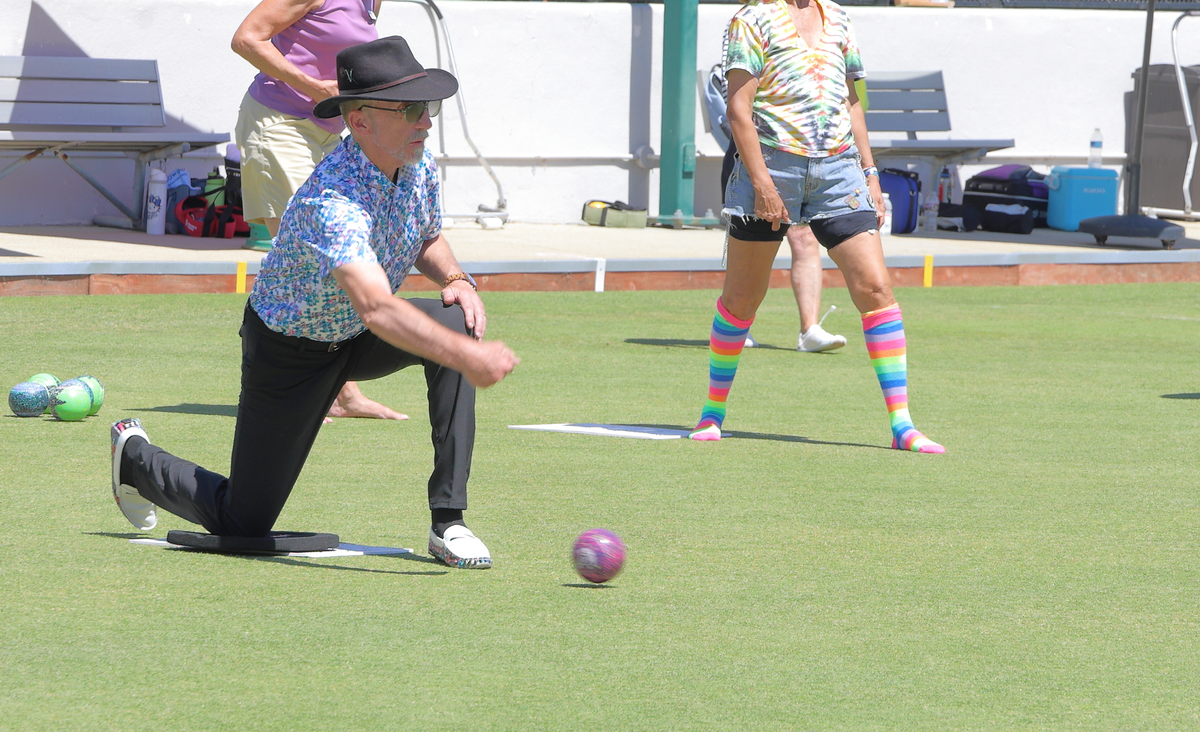

The Parks and Recreation Advisory Commission voted Tuesday night to form an ad hoc pool subcommittee, on a tight mandate and a six-month clock. Neighboring cities' pool projects, and Hermosa Beach's own dog park campaign, tell us that the real work is all still to be done.

Tuesday night's City Council meeting had a bit of everything: a heartfelt tribute to one of Hermosa's most familiar civic voices, a long-simmering fight over vacation rentals that finally came to a head, and a feel-good update from a beloved local club celebrating its 90th year.

Facing a budget hole that could hit $4.2 million, Hermosa Beach is turning to the very thing it spent a decade banning: short-term rentals

Hermosa Beach is making it easier to build condos. The Planning Commission voted Tuesday to drop a longstanding permit requirement and speed up approvals for smaller projects, following new state housing rules.
By Hermosa, for Hermosa. Join The Review today.