The Parks and Recreation Advisory Commission voted Tuesday night to form an ad hoc pool subcommittee, on a tight mandate and a six-month clock. Neighboring cities' pool projects, and Hermosa Beach's own dog park campaign, tell us that the real work is all still to be done.
Tuesday night's City Council meeting had a bit of everything: a heartfelt tribute to one of Hermosa's most familiar civic voices, a long-simmering fight over vacation rentals that finally came to a head, and a feel-good update from a beloved local club celebrating its 90th year.
Council Kills Greenbelt Dog Park Ballot Measure, Advances Study Agreement
Hermosa Beach voters won't see a Greenbelt dog park question in November. The City Council declined 5-0 to place the measure on the ballot Tuesday, though it separately approved a privately funded feasibility study of both the Greenbelt and Valley Park East on a 3-2 vote.
The City Council on Tuesday night declined to put a Greenbelt off-leash dog park question before voters in November, but narrowly approved a memorandum of understanding letting the nonprofit Bark For A Park pay for and lead feasibility studies of two potential sites — including the Greenbelt parcel the council had just refused to send to the ballot.
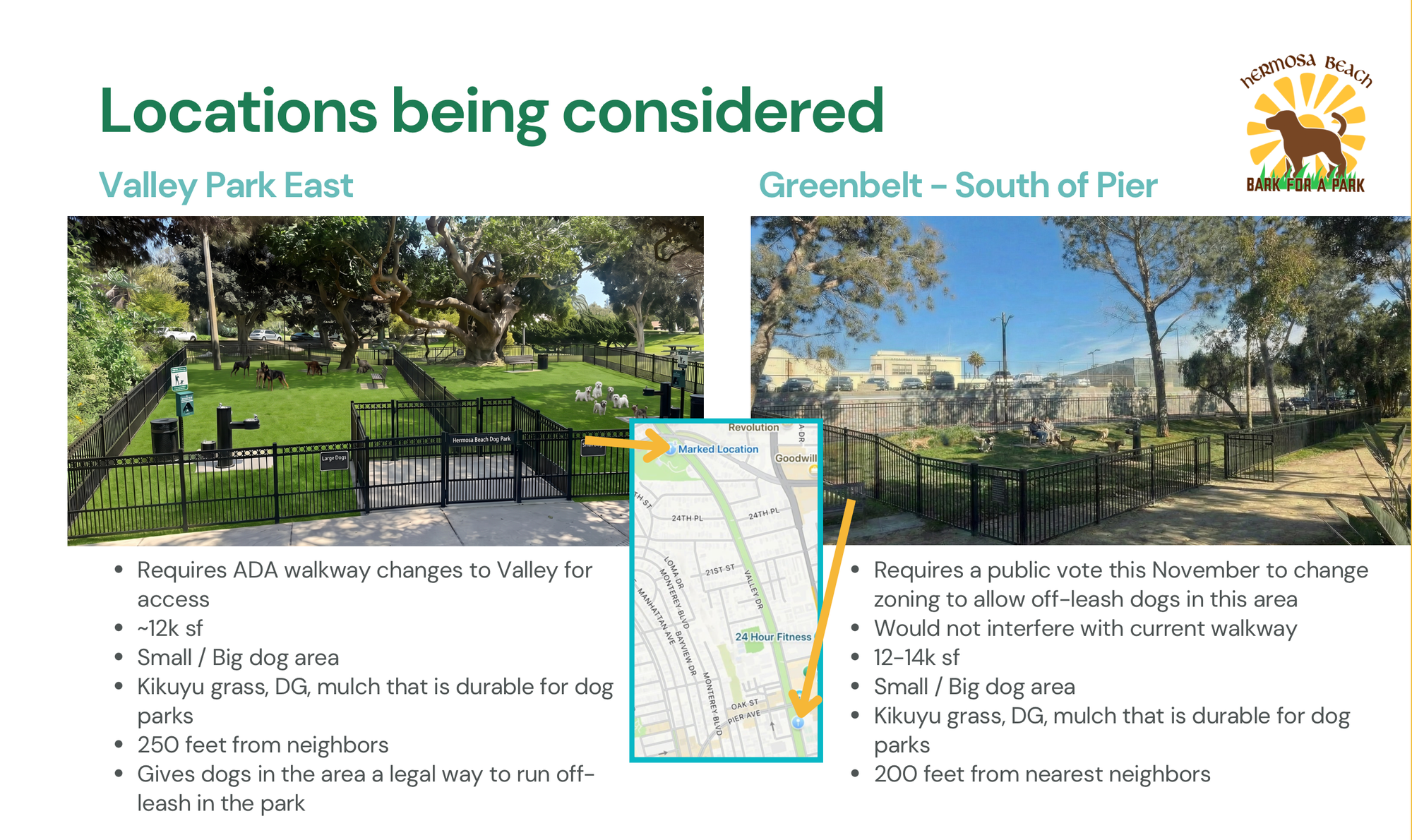
The first of two proposals asked the council to enter an agreement with Bark For A Park, which has offered to fund and manage the next phase of feasibility work on the two locations the council designated on May 12: Valley Park East as the primary site and a portion of the Greenbelt south of Pier Avenue as a secondary one. The agreement covers pre-development work only — feasibility analysis, conceptual design, environmental review, permitting and related planning — and approves no park, authorizes no construction and creates no entitlements.
The two proposed locations, outlined in Bark For A Park's campaign literature
As drafted, the agreement required the nonprofit to reimburse the city for actual project-related staff, legal, engineering, environmental review, consultant, administrative, project management and plan check costs, with no ceiling — an approach the staff report defended on the grounds that "the level of City involvement cannot be determined in advance."
Bark For A Park countered with a side letter asking that staff-cost reimbursement be capped at 10 percent of its current $140,000 project budget, or $14,000, with a mechanism to renegotiate if costs run higher. Parks and Recreation Manager Brian J. Sousa's report recommended against it in writing: "Staff does not recommend this request because it could prevent the City from recovering its actual Project costs."
At the dais, staff softened. Asked directly whether the department could live with a ceiling, a staff member told the council: "Staff is not opposed to the 10 percent cap if that's what council wants. We'll make it work."
"We're a small nonprofit, 100 percent of our funds raised by private donations toward a project that if implemented will be operated for the public's benefit," board vice chair Jack Levy told the council by Zoom, thanking City Manager Steve Napolitano for the assurance. "I'd be surprised if anybody in this room would agree to a contract that allows a vendor to charge unlimited time." Without a cap, he said, the board had voted the deal was a "deal-breaker."
Councilmember Rob Saemann, who pulled the agreement off the consent calendar for discussion, moved to approve it with the cap — but also to strike the Greenbelt from the study entirely and proceed on Valley Park alone. "I don't think they ever really bargained for the Greenbelt and the Valley Park spot," he said. "I think it was a mistake then and I think it's a mistake now."
City Attorney Jason Baltimore advised that removing a site would be a material change requiring the agreement to return to a future meeting. Mayor Pro Tem Michael Keegan seconded Saemann's motion anyway. Councilmember Dean Francois — who authored the May amendment that added the Greenbelt — then offered a substitute motion to approve the staff recommendation with the cap and both sites intact.
The substitute passed 3-2, with Keegan, Francois and Saemann in favor and Councilmember Ray Jackson and Mayor Mike Detoy opposed.
Detoy's objection was about Valley Park East itself — 70 children a week in summer camp, Shakespeare in the Park, and the natural amphitheater nearby. "It is a great open space that is going to turn to a dirt pit," he said.
Saemann pushed back hard on the fiscal argument. "This is not city money. These people have raised an incredible amount of money and done an awful lot of work in order to bring to our city an asset," he said, comparing the opposition to warnings he heard 13 years ago about the Greenbelt's ADA path. "Why are we not gonna let them give this city this wonderful gift of a dog park?"
The ballot measure: no action, 5-0
The second proposal would have called a general municipal election for November 3 and asked voters to partially amend the 1989 voter-approved ordinance that preserved the Greenbelt for parkland and open space and requires dogs there to stay on leash.
Staff stressed repeatedly, in the report and at the dais, that the measure would approve nothing — no park, no construction, no funding obligation. The recommended action also asked the council to designate members to write arguments for and against, and to pick a preferred ballot letter. The incremental cost of putting it on the ballot was estimated at roughly $1,400, payable to the Los Angeles County Registrar-Recorder.
Council members didn't think voters would read it as narrowly as staff did. Francois said he could not support the resolution as drafted because the recommended action named no location or size, and proposed four changes: privately funded construction, the site limited to Pier Avenue to 11th Street, a 400-by-40-foot maximum, and a 100-foot buffer from the nearest residential lot.
"People are going to go, well, I'm not going to vote for the dog park because it could be four times that size and it could be right next to the 9-11 memorial," he said. His motion with those four modifications died for lack of a second.
Keegan then moved to receive and file the report — no action, no measure. It passed 5-0.
Heidi Fernandez, a resident since 1981, read the results of the two competing 1989 Greenbelt measures aloud. The one that would have allowed dogs off-leash on the railroad right-of-way failed, 898 to 473. The one that preserved the land as parkland and open space and required dogs on leash passed, 925 to 459. "The people have already voted on the issue that you are attempting to change," she said.
Jim Rosenberger, who served on the council in the 1980s and on the committee that negotiated the Greenbelt purchase, brought the 1989 campaign literature with him. "We're all paying to obtain this beautiful Greenbelt for open space — seven and a half million dollars," he read. "We shouldn't have to worry about off-leash dogs bothering, barking or attacking us and our children. Ninety-five percent of us don't own dogs... We think they're barking up the wrong tree."
Supporters argued the process was the point, not the outcome. "This does not predetermine the outcome," one Bark For a park board member noted. "It creates the process needed to replace assumptions and misinformation with facts."
Several speakers noted the timing problem: the council had spent the earlier part of the same meeting approving a sales tax measure for the November ballot on the strength of the city's budget crisis. "We are asking people to raise sales taxes saying we don't have money, and they're gonna see a ballot measure that says and we're also trying to approve a dog park," one speaker said. "They're not gonna have that level of nuance that we have here tonight."
What happens next
Tuesday's vote does not stop study of the Greenbelt. The staff report notes that continued feasibility analysis of both sites "may proceed administratively and does not require additional legislative authorization" — the ballot measure was needed only to make a Greenbelt park legally possible, not to evaluate one.
In practice, though, the two sites will not be compared on equal terms. Bark For A Park has told staff it will begin comprehensive feasibility work on Valley Park East as soon as the agreement takes effect — budget analysis, design, ADA requirements, potential environmental review — but will not spend donor money on the same study for the Greenbelt without a favorable vote. The council can expect a full study for one site and, at most, a conceptual rendering for the other.
Public works staff have said the department has no capacity to take on the project for roughly two years regardless. Keegan offered the group a different route. "My suggestion to them is if you don't get what you want today, work for candidates that want to put your park in — and there's an election in November."
The Parks and Recreation Advisory Commission voted Tuesday night to form an ad hoc pool subcommittee, on a tight mandate and a six-month clock. Neighboring cities' pool projects, and Hermosa Beach's own dog park campaign, tell us that the real work is all still to be done.
Tuesday night's City Council meeting had a bit of everything: a heartfelt tribute to one of Hermosa's most familiar civic voices, a long-simmering fight over vacation rentals that finally came to a head, and a feel-good update from a beloved local club celebrating its 90th year.
Hermosa Beach is making it easier to build condos. The Planning Commission voted Tuesday to drop a longstanding permit requirement and speed up approvals for smaller projects, following new state housing rules.