State drops wage case against Rock n' Roll Car Wash, 19 months after it was forced to close. Owner Chris McKenna says that they have acted as 'judge, jury and executioner' in his case.
Hermosa Beach council honors Olympic coach, advances Clark Field upgrades, pushes fee increases
Council meeting opened by recognizing two pillars of the community — a gold-medal winning hockey coach and a century-old civic club — before working through a heavy agenda that included a contested fee study, Little League field improvements and police vehicle contracting.
John Robleski, US Women's Ice Hockey head coach and Hermosa resident, was honored this week following the team's gold medal victory at this year's Winter Olympics
The council presented a proclamation to John Robleski, head coach of the U.S. Women's National Ice Hockey Team and a Hermosa Beach resident, following Team USA's gold medal victory at the 2026 Winter Olympics in Milan-Cortina.
The proclamation noted that Robleski is the only coach in International Ice Hockey Federation history to win gold with both a men's and women's national team. He joined the LA Kings organization in 2020 to coach the Ontario Reign and settled in Hermosa Beach, where he also serves as a Little League dad and coach.
Robleski, who threw out the ceremonial first pitch at Clark Field in February to open the 75th Hermosa Beach Little League season, told the council he wears the city's name with pride when he travels. He also revealed that the U.S. Olympic team awarded him their Order of Icos medal — a USOC honor the team can bestow on one person of their choosing.
Kiwanis Club marks 100 years
The council also recognized the Hermosa Beach Kiwanis Club on its centennial. The club, founded in 1926, has held more than 5,000 consecutive weekly meetings. Its clubhouse on Valley Drive, built in 1957, was marked by a restored mural re-unveiled in January.
In a turn the council found fitting, the Kiwanis presented a Certificate of Appreciation to the city in return, recognizing 100 years of partnership and civic collaboration. The club is hosting a free public birthday celebration May 9 at noon at Kiwanis Hall, 2515 Valley Drive.
Fee increases approved with phase-in, key items pulled for review
The council's most time-consuming item was a public hearing on a comprehensive fee study update conducted by Revenue Cost Specialists, the city's first such review since 2016. Finance Director Brandon Walker said the city is currently only recovering roughly 63 cents on the dollar in Community Development and planning fees and about 78 cents in Public Works — a gap he said amounts to more than $1 million annually in general fund subsidization.
Walker said moving to full cost recovery could generate up to $1 million in additional annual revenue and that fees would shift from a property-value basis to a square footage model for planning and building permits. He also proposed a new conditional use permit annual monitoring fee and increases across a range of permit types.
Public comment was broadly skeptical of the scope and timing. Speakers questioned whether the city had examined its own process inefficiencies before passing costs to applicants, noted that some fees would more than double, and raised concerns about the impact on small businesses and housing production. Several called for tying fee increases to streamlining measures in the ongoing zoning code update.
After extended council deliberation, the majority backed a two-year phase-in of 50 percent in the first year and the remaining 50 percent in the second, with a review in year three.
However, roughly 19 specific fee items — including the CUP application fee, planned development permit, variances, the new annual CUP monitoring fee, mural permit, food truck permit and residential encroachment permit — were pulled from the package at council direction. Individual council members are to submit their concerns to staff by Sunday for inclusion in a staff report, with the pulled items returning for discussion at the May 12 meeting.
Little League MOU for Clark Field improvements approved
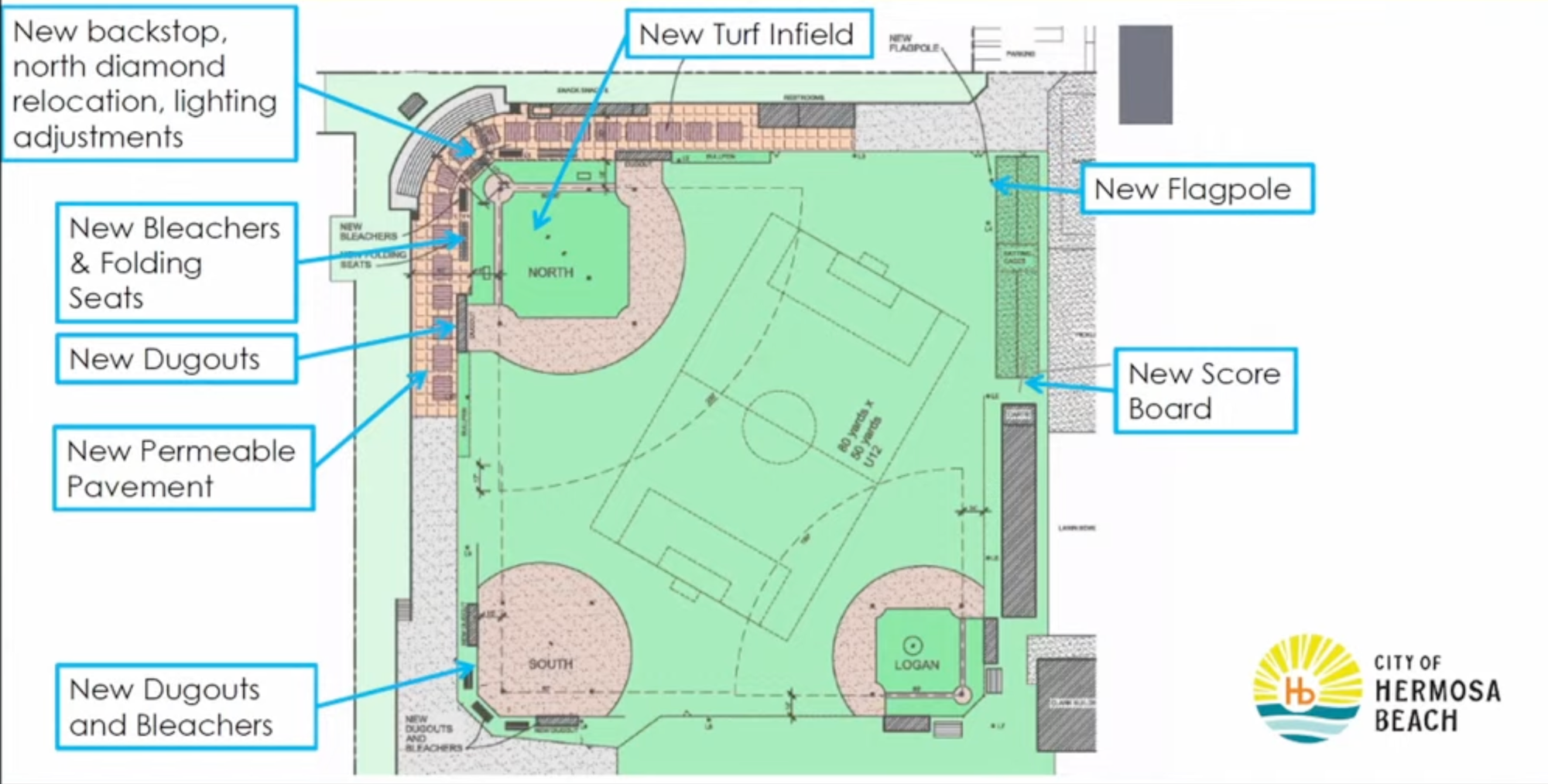
The council unanimously approved a three-year memorandum of understanding with Hermosa Beach Little League to advance planning, design and permitting for a suite of proposed improvements at Clark Field.
The proposed improvements, which Little League representatives say would be fully self-funded through a fundraising campaign, include a new synthetic turf infield, a redesigned backstop with the potential to shift the northern diamond slightly northwest, new bleachers, upgraded lighting, permeable pavers along the loop road and a new scoreboard. Little League has agreed to cover all associated city staff time and plan check fees.
Public Works Director Joe Sanclemente noted the MOU is limited to the planning and design phase. Any construction would require a separate MOU and council approval.
Granny's encroachment fee questioned
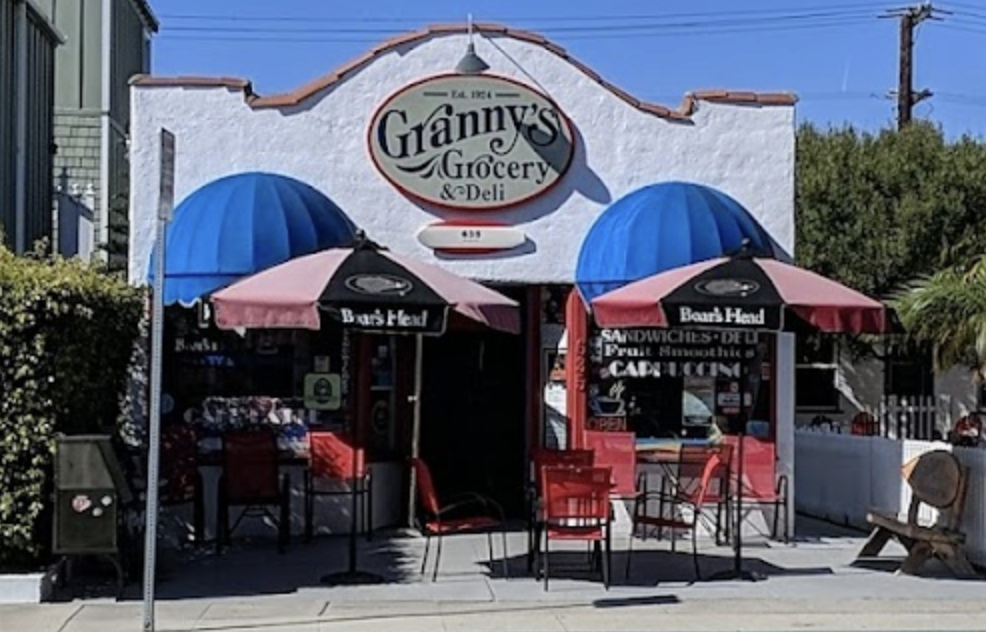
A resolution establishing a reduced encroachment fee for dining areas without table or alcohol service generated significant public comment from owners and supporters of Granny's, the 102-year-old neighborhood market on Monterey Boulevard.
Staff had proposed a new $1-per-square-foot fee for that category, retroactive to January 1. But the item surfaced a complication: Granny's is located in an R-3 residential zone, not a commercial one, and the property's front seating area sits on city right-of-way. The business had never previously been billed for encroachment fees, and city staff acknowledged it had not been contemplated when the commercial encroachment program was established.
Granny's front patio has been a community gathering spot since 1924.
The owners told the council that the patio has served as a community gathering space for more than a century, open to anyone regardless of whether they make a purchase. They submitted a petition with nearly 900 signatures.
The council directed staff to return with a modified resolution that applies the commercial encroachment fee only to businesses in commercially zoned areas, explicitly excluding commercial activity in residentially zoned properties.
Police vehicle outfitting contracts authorized
The council approved contract authority allowing the city manager to enter into five-year agreements with three police vehicle outfitting vendors — at up to $1 million each — to create a bench of contractors for equipping new and replacement police vehicles.
Finance Director Brandon Walker explained the city currently relies on South Area Regional Communications for outfitting but has experienced delays of up to six months due to backlogs. Two newly received Chevy Tahoe patrol vehicles are currently sitting undeployed pending outfitting. Three qualified vendors responded to a city outreach; the contracts carry no guaranteed spending and require no appropriation tonight.
Several council members raised concerns about whether the city may be paying twice — once through embedded costs in its RCC dispatch contract and again through the new vendors. Council directed staff to review the RCC contract and use the newly authorized vendor agreements as leverage to push for compliance before spending against the new contracts. The leverage idea was credited to Public Works Director Sanclemente during the discussion.
Mayor Pro Tem Michael Keegan suggested the city explore including dispatch services in the scope of its ongoing fire services bid negotiations with Redondo Beach, a point that drew support and was added as a future agenda item.
Other business and future items
Future agenda items directed by the council include a review of sidewalk vending permits and locations, the dispatch bid as part of fire service negotiations, and an action item directing staff to bring back potential short-term rental regulations that may expand STR opportunities in the coastal zone — along with comparable programs from other coastal cities.
The next regular council meeting is May 12 at City Hall, with closed session at 5 p.m. and open session at 6 p.m.
The Parks and Recreation Advisory Commission voted Tuesday night to form an ad hoc pool subcommittee, on a tight mandate and a six-month clock. Neighboring cities' pool projects, and Hermosa Beach's own dog park campaign, tell us that the real work is all still to be done.
Tuesday night's City Council meeting had a bit of everything: a heartfelt tribute to one of Hermosa's most familiar civic voices, a long-simmering fight over vacation rentals that finally came to a head, and a feel-good update from a beloved local club celebrating its 90th year.