
Hermosa Beach's Q2 Serious Crime Stayed Flat Versus Last Year
Second quarter serious crime stayed flat year over year, but cases of assault rose sharply. General trends remain downwards year-to-date.
Stormy waters as Tuesday's Public Works meeting reopens some old wounds for Greenbelt neighbors

Seven years after Hermosa Beach cancelled a massive stormwater project on its Greenbelt — at a cost of a $3.1 million state grant, hundreds of thousands of dollars in repayments to neighboring cities, and a good deal of regional goodwill — the city came back to its Public Works Commission last Tuesday with a far smaller proposal that touches some of the same ground. It got some of the same reception.
The July 15 meeting drew a procession of Greenbelt-adjacent residents to the podium, several of them veterans of the fight that killed the original project in 2019. By the end of the night, the commission had declined to do what staff asked of it. The staff report's written recommendation was specific: endorse "Option A" — eight dry wells in South Park and five on the Greenbelt north of 2nd Street — and recommend it to City Council. The alternative, Option B, would pair the same eight South Park wells with five in and around Bicentennial Park instead. The commission endorsed no option and made no recommendation to council. What passed instead, 5–0, was a deliberately open-ended substitute: move the dry well concept forward "considering both A and B and other possible options," submit the grant application with that flexibility built in, and have staff study the sites and come back to the commission — not proceed to council — once real data exists. In a pointed friendly amendment authored by Commissioner Scott Hayes, the commission also directed that the city attorney determine, "as soon as practicable," whether the city can legally build on the Greenbelt at all.
"I'm a little disappointed that hasn't already happened," Hayes said.
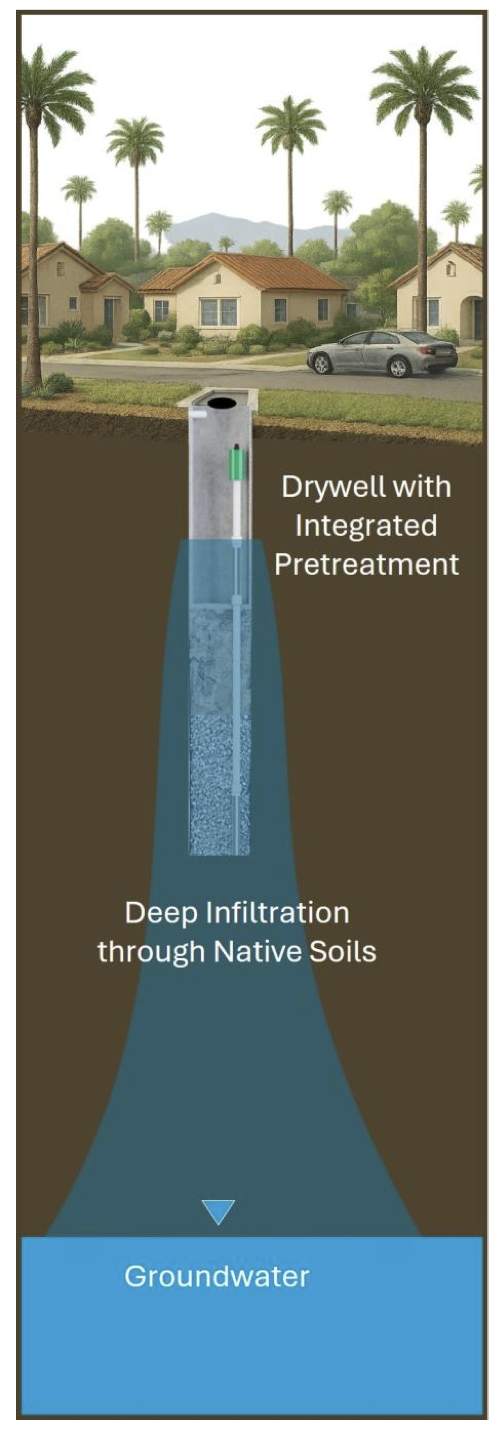
The proposal, known in the city's budget as CIP 438, is 13 dry wells: eight along the eastern walkway of South Park, plus five more in one of two locations — the Greenbelt just north of 2nd Street (staff's recommended Option A, estimated at $3.9 million) or in and around Bicentennial Park (Option B, about $4.9 million).
There is one catch, and it is the crux of everything that followed Tuesday night: a dry well only works if the soil beneath it is dry. It drains through unsaturated ground. If the bottom of the well sits at or below the seasonal water table, it cannot infiltrate — it just fills.
None of this is optional. Hermosa Beach, together with Manhattan Beach, Redondo Beach, Torrance and the L.A. County Flood Control District, is bound by a state stormwater permit and a watershed management plan that require the city to capture a specified volume of polluted runoff before it reaches the ocean. The compliance deadline — assuming a pending extension is granted — is 2031. Miss it, and staff says the city faces fines of up to $20,000 per wet-weather day, potentially more than $600,000 a year, plus exposure to third-party lawsuits.
The city has completed one of its two required projects, the Hermosa Avenue Green Street improvements. The dry wells are the other. To pay for them, Hermosa and Redondo Beach are filing a joint application to the county's Safe Clean Water program by July 31, seeking roughly $1 million to fund design and engineering. The city has about $1.3 million of its own set aside — enough, perhaps, for a first phase, but not for the whole project if grants fall through.
That July 31 deadline is why the item came to the commission when it did, with staff candid that the site plans are, in their words, "dots and lines on a map."
To understand why dots on a map drew a crowd, you have to go back a decade.
The original 2016 watershed plan called for a single enormous solution: a block-long concrete infiltration chamber — roughly 25,000 square feet — buried beneath the Greenbelt between Herondo and 2nd Street, capturing runoff from nearly 3,000 acres spread across Torrance, Redondo Beach and Hermosa. Earlier planning, from roughly 2011 to 2014, had contemplated a suite of smaller, distributed projects across the watershed cities. Somewhere in the technical recalibrations of 2014 and 2015, those became one big project, and the big project landed on Hermosa's most beloved strip of open space.
Almost nobody who lived next to it knew. The site had been identified in 2015, but it sat inside hundreds of pages of technical watershed documents. Many neighbors first learned of the project at a community meeting in March 2018 — after the city had accepted a $3.1 million state grant and awarded a design contract. When then-Mayor Jeff Duclos asked the project's consultant whether planners had ever considered the more than 700 residents living within 500 feet of the site, her answer was memorable: "No, and that obviously was an oversight." The city manager at the time conceded the city's outreach "has been lacking"; Councilmember Mary Campbell allowed that "if we blundered something here, it might be the close engagement with our community."
On the council, the project's most vocal defender was Justin Massey, an 'environmental attorney' elected to City Council in 2015, who warned that walking away could expose the city to federal penalties "that can approach $37,500 per day." The record does not support laying the project's expansion at any one official's feet — that happened inside a five-agency technical process — but Massey, who left the council after the November 2024 election, remained its leading advocate (together with former City Manager Suja Lowenthal) as opposition built, before ultimately joining the majority that abandoned the site in March 2019. At least one speaker Tuesday still remembers it that way: longtime resident Marion Pearl told the commission the council of that era "thought it's a great idea to put a big tank into the Greenbelt and invite everybody to flow that water in there. So we woke up to it."
The cancellation was expensive. The state pulled its $3.1 million. The city says it returned nearly $268,000 to its partner cities (Redondo's mayor at the time demanded more, in a letter accusing Hermosa of bowing to "public pressure rather than design or other substantive concerns") and paid another $160,000 for the feasibility study that would identify replacement projects. That study, in 2022, recommended what the neighbors had suggested all along: smaller, distributed dry wells, capturing only Hermosa's own runoff, sited east of Pacific Coast Highway on high ground.
Which brings us to the part of the story that animated Tuesday's crowd. For four years, the plan of record was roughly 23 dry wells east of PCH — where, according to the consultant's own desktop review, groundwater sits more than 150 feet below the surface. This spring, staff and the consultant reassessed. Twenty-three wells across 20 scattered residential sites meant years of dispersed street construction and an estimated $7 million cost. Thirteen wells at two consolidated park sites, closer to the county storm drain lines they would tap, could hit the same state-mandated capture volume for roughly $3.9 million. Asked directly when and why the change happened, staff was honest: "There was no moment... it's kind of evolved," driven by cost, construction impact and a looming deadline.
The problem, residents argued, is that the cheaper geography may be the worse hydrology — and they came armed with the city's own files to say so.
Deborah Sanowski, whose townhome abuts the proposed Greenbelt site, submitted a 40-page package assembling every groundwater measurement on record for the corridor, most of it generated by the city's own consultants during the last project. The seasonal high water table there, per regional monitoring, is about 15 feet below the surface. County guidelines require a dry well's bottom to sit at least 10 feet above seasonal high groundwater — which, she calculates, makes the deepest compliant well at that location about five feet, not the 20 to 30 feet proposed. The consultant's own 2017 memo for the earlier project capped acceptable infiltration depth there at 15 feet. Its own 2017 borings computed liquefaction failures — soil that loses strength in an earthquake when saturated — at depths squarely within the proposed well band. "Your own consultant found soil that fails in an earthquake when wet," resident Susan Zigband told the commission. "And this project's whole job is to make that soil wet. Where is that analyzed? Nowhere in 400 pages."
And beneath the engineering sits a legal question with its own history: the Greenbelt is zoned OS-1 restricted open space under a 1989 voter initiative, Proposition F, which permits only a narrow list of improvements and — per a 2018 city attorney memo written during the last fight — can only be amended by another public vote. Whether 20-to-30-foot stormwater shafts qualify as a permitted improvement is, at minimum, not obvious. Asked Tuesday whether the city attorney had reviewed the question, staff answered: "Not yet... We have a feeling, but it hasn't been fully vetted."
Asked whether anyone knows where the water table is at the proposed sites, staff answered that too: "No. And that's what these grant funds will determine." If borings find groundwater at 15 or 20 feet, "we have to punt."
It would be easy — and residents' "déjà vu all over again" refrain invites it — to write this as the same movie replaying. It isn't, quite, and fairness requires saying so.
The city mailed 2,470 notices to everyone within 500 feet of the proposed sites before a single design dollar has been spent — the inverse of 2016, when design was underway before neighbors knew. Staff repeatedly framed the sites as provisional, said the grant program allows locations to move, and committed to wet-season groundwater studies this winter — an anticipated El Niño year, which one commissioner noted would provide usefully pessimistic data. Tracy Horowitz, a Parks and Recreation commissioner who says she was "instrumental in working with the city to stop the 2016 project," rose Tuesday not to object but to praise the early transparency: "We know the project has to happen. It's very early... the transparency that the city is showing right now is really, really appreciated."
And the commission itself did not rubber-stamp. Asked to bless a specific site plan, the five commissioners — two of whom, Erin Bender and Nate Flory, were seated for their first meeting — blessed none: the vote stripped the Option A endorsement out of staff's recommended action, kept east-of-PCH implicitly alive alongside "other possible options," demanded the legal opinion first, and required staff to return to the commission with a more detailed conceptual design before anything advances. Just before calling the vote, Chair David Grethen asked whether anyone wanted to weigh in on A versus B at all — and the answer was to leave it "completely open." The closest the dais came to a preference was one commissioner's conditional lean toward Option A on cost grounds — it could save "maybe half as much" — if, and only if, the water table proves workable; that preference did not make it into the motion. Staff, for their part, said the watered-down language costs the grant application nothing: the funding agency cares about the volume of water captured, not where the wells sit. Scott Hayes put the underlying dilemma plainly: without engineering answers no site can be responsibly recommended, but the engineering answers cost money the city doesn't have until the grant comes through. It is, he believes, "a catch-22."
Still, the uncomfortable pattern is visible to anyone who lived through the first round: a siting decision surfacing close to a funding deadline, justified by cost, with the threshold questions — is it legal, does the ground even work — scheduled to be answered after the application is filed rather than before. The city's defense is that this is how competitive grant funding works: you need "something that looks feasible" to get the money that pays for finding out what is actually feasible. That is true, and it is also precisely the dynamic that produced 2019's expensive reversal, when the state yanked its grant over "uncertainty about the project scope, outcomes and benefits."
The stakes of getting it right are not abstract. The fine clock is real, the 2031 deadline is real, and the ocean at the Herondo outfall really is dirty after every storm — a problem everyone at Tuesday's meeting, staff and residents alike, said they want solved. Nobody spoke against dry wells. Nobody spoke against clean water. The dispute is fifty vertical feet of geology and a few thousand horizontal feet of geography: whether the wells belong on cheap, low, wet ground next to homes, or expensive, high, dry ground under streets.
Seven years ago, Hermosa Beach learned what it costs to answer that kind of question too late and without transparent public process. The commission's questioning this week suggests that lessons may have been learned. But the solution is no closer, and the financial pressure no easier.

The Parks and Recreation Advisory Commission voted Tuesday night to form an ad hoc pool subcommittee, on a tight mandate and a six-month clock. Neighboring cities' pool projects, and Hermosa Beach's own dog park campaign, tell us that the real work is all still to be done.

Tuesday night's City Council meeting had a bit of everything: a heartfelt tribute to one of Hermosa's most familiar civic voices, a long-simmering fight over vacation rentals that finally came to a head, and a feel-good update from a beloved local club celebrating its 90th year.

Facing a budget hole that could hit $4.2 million, Hermosa Beach is turning to the very thing it spent a decade banning: short-term rentals

Hermosa Beach is making it easier to build condos. The Planning Commission voted Tuesday to drop a longstanding permit requirement and speed up approvals for smaller projects, following new state housing rules.
By Hermosa, for Hermosa. Join The Review today.