Tuesday's agenda charts opposite paths for two sports at the same facility. Pickleball is poised for expanded access after a million-dollar renovation. Basketball hopes to rescue hoops removed after an unscheduled safety review
The police department is already running overtime patrols to assist with public safety concerns, including problems with e-bikes. Now council will decide whether to provide that effort with new resources.
Hermosa Beach faces a $548K budget shortfall at midyear, with projected spending increases vs. original forecast outpacing revenue gains 3-to-1. Staff proposes one-time funds to close the gap for the third straight year.
Jumping Through Hoops : Pickleball And Basketball Facilities Under Scrutiny
Tuesday's agenda charts opposite paths for two sports at the same facility. Pickleball is poised for expanded access after a million-dollar renovation. Basketball hopes to rescue hoops removed after an unscheduled safety review
City Council will consider a pair of reports on Tuesday that together amount to a recreation reset at Clark Field, the city-owned sports facility on Valley Drive that houses tennis courts, a ball field, and the Kelly Pickleball Courts.
One report asks Council to choose among three options for pickleball court hours now that a capital improvement project is restoring the facility to its full four-court configuration. The other asks Council to approve the permanent removal of three of six basketball hoops along the western edge of Clark Field, roughly 100 yards from the pickleball courts.
The two items are unrelated in their operational details but share a common venue, the same advisory commission review at the February 10 meeting, and a question that connects them: how the city allocates recreational space and who benefits from those choices.
Pickleball: Four Courts, Three Options
Two of the four Kelly Pickleball Courts have been closed since 2020. CIP 619 is restoring all four, with reopening projected for late April. Staff is recommending Council update the use policy and choose one of three options for hours.
Option 1 would add Sunday hours to the existing schedule, bringing weekly access from 45 to 52 hours. Option 2 would open the courts 9 a.m. to 9 p.m. daily, totaling 84 hours. Option 3, recommended by the Parks and Recreation Advisory Commission, would maintain the current schedule and require a 120-day report back on complaints, feedback, and usage.
The current hours were set in July 2021 following a stakeholder process balancing pickleball demand against neighborhood noise complaints. That produced a compromise: courts open five days a week, closed Sundays and Mondays, limited evening hours.
The city has made a substantial investment in the facility since then. CIP 619 carries a total budget in excess of $1 million, and Council awarded an $825,000 construction contract in November 2025. The project expanded over time from a resurfacing job to a full modernization including lighting upgrades and ADA-compliant pathways. With that kind of money spent, the case for maintaining the most restrictive hours option becomes harder to make on fiscal grounds alone. At the current schedule's projected revenue of $42,900 per year, the construction contract alone would take nearly 20 years to recoup from court fees. Option 2's projected $79,800 would cut that roughly in half.
Staff's report also argues that demand has outgrown the existing schedule. Membership grew from 204 in the program's first year to 290 in 2024. Before the courts closed for construction, they were reserved 98 percent of the time. The report notes the Kelly Courts sit 190 to 480 feet from the nearest residences, comparing favorably to facilities in Manhattan Beach (50 to 280 feet), Redondo Beach (60 to 180 feet), and other South Bay cities that operate significantly more hours.
A new Thursday evening adult league is expected to generate an additional $10,000 regardless of which option Council selects.
The Commission voted February 10 to recommend maintaining current hours, citing potential noise from two additional courts.
Hoop Dreams
The basketball item is shorter and more procedurally unusual. It also arrives with a backstory that the staff report only partially tells.
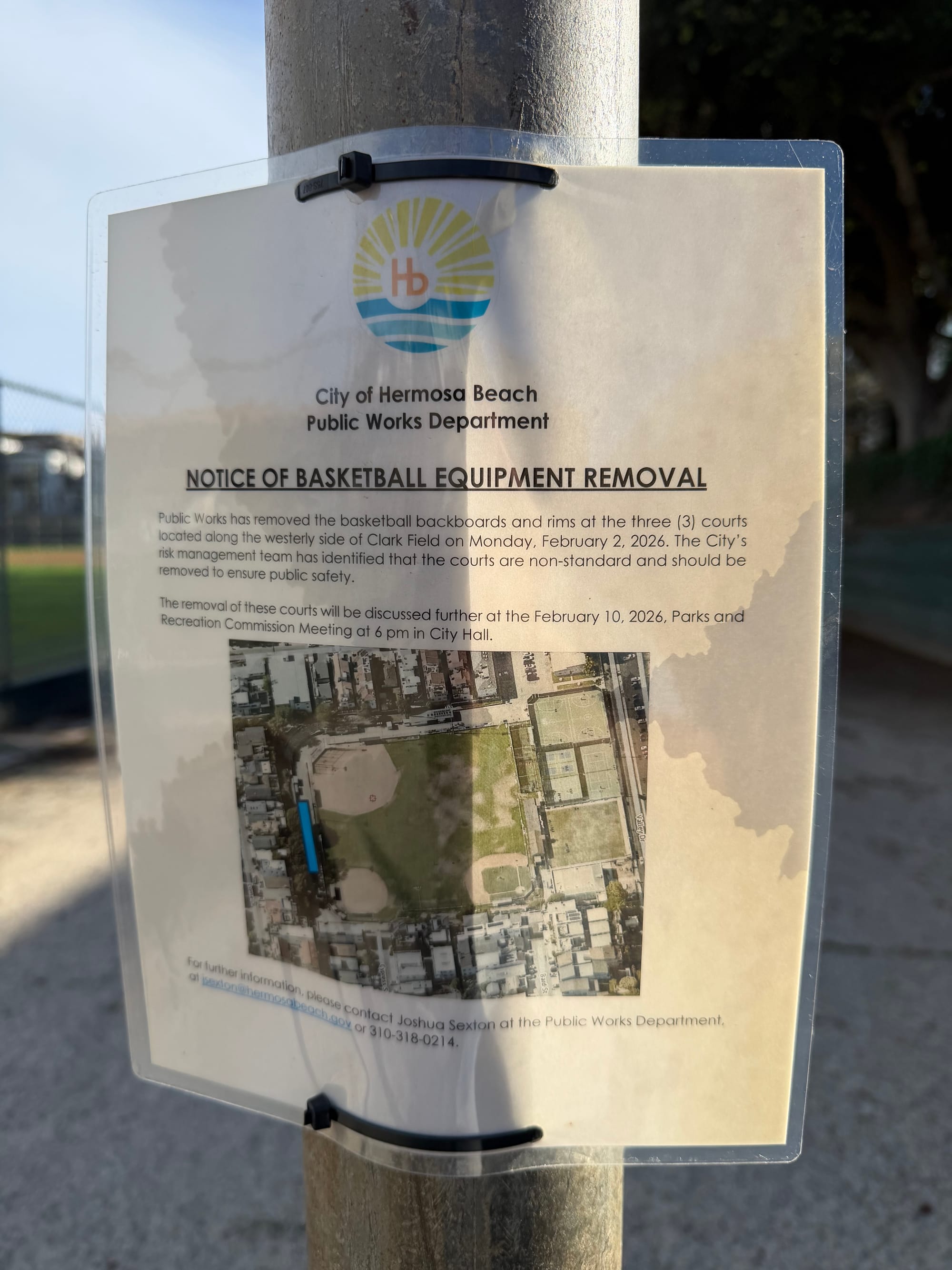
On February 2, Public Works crews removed all six backboards and posted notices directing the public to the February 10 Commission meeting. The removal happened eight days before the Commission discussed the matter. As The Hermosa Review reported at the time, the move caught the neighborhood off guard and generated a 450-signature petition in less than a week.
The hoops were removed without prior notice in February after an unscheduled safety review
The staff report attributes the removal to findings by the city's risk management team. What it does not specify is that the review was actually triggered by a resident complaint about deteriorating asphalt. City Risk manager Boyd Horan presented the legal analysis to the Commission on February 10, laying out the liability exposure under Government Code Section 835, which establishes municipal responsibility for dangerous conditions on public property. The playing area measures roughly 60 by 24.5 feet per court, well below the standard half-court dimensions of 50 by 47 feet, with only three feet of buffer between the playing surface and a retaining wall on one side and a baseball field fence on the other.
The hoops have existed in this configuration for years. Under the legal framework Horan presented, they became an actionable risk once formally identified. The Council vote itself is framed in the staff report as a defensive measure: formal approval of the three-hoop plan would constitute a "deliberative policy choice" rather than "inadvertent neglect" should an injury claim arise.
But the February 10 Commission meeting made clear the community was not ready to accept removal as a foregone conclusion. Neighbor Renee Siemak described the hoops as a lifeline for neighborhood children who have few alternatives: homes without backyards, streets too busy for portable hoops, school courts locked and gated. Dan Madden, president of Hermosa Beach Youth Basketball, noted that the league's 1,000 kids have no public courts in the city with hoops below 10 feet. The Clark Field hoops, set at eight and nine feet, were the only option for younger players. Ten-year-old Elias Brafman LaMonica told the Commission simply that the hoops were important and that there was a way to fix them without taking them out.
Commissioner after commissioner signaled agreement. Vice Chair Traci Horowitz urged staff to "find a way to say yes to the kids." Commissioner Elka Worner argued the hoops provided a rare space for children to exercise and let off steam. Commissioner Tom Moroney suggested reducing the six hoops to three at varying heights, which is essentially the configuration staff is now recommending. The motion to restore hoops with safety modifications passed unanimously.
Following that meeting, staff met February 25 with nearby residents and Madden. One hoop was restored the next day. The recommendation now before Council would keep three hoops (one at 8 feet, two at 9 feet) all facing the same direction to discourage organized play, install "Use at Your Own Risk" and "No Organized Games" signage, and resurface the asphalt at an estimated cost of $11,000.
What to Watch Tuesday
On pickleball, the central question is whether Council follows the Commission or sides with staff on expansion. The 98-percent reservation rate and the scale of the city's investment are powerful talking points. If the neighborhood doesn't mobilize, Option 1 appears to be the path of least resistance. Option 2 would make the faster case for recouping the renovation cost but would eliminate the last closed day entirely, a harder sell given the 2021 stakeholder compromise.
On basketball, the staff recommendation largely reflects what the Commission asked for unanimously in February. The question is whether Council has anything to add about the process that produced it, or whether the 450 signatures and the testimony of the kids who use those hoops have already done their work.
The police department is already running overtime patrols to assist with public safety concerns, including problems with e-bikes. Now council will decide whether to provide that effort with new resources.
Hermosa Beach faces a $548K budget shortfall at midyear, with projected spending increases vs. original forecast outpacing revenue gains 3-to-1. Staff proposes one-time funds to close the gap for the third straight year.
A year-long structural assessment of the Hermosa Beach pier comes to City Council Tuesday — with a cost-benefit analysis that could reframe how the city thinks about the structure's future.