
Final Election Debate : City Council Hopefuls Face Off Again
Third and final City Council Candidate debate promised fireworks with 'challenge card' system. The format ultimately delivered more consensus than disagreement.
Third and final City Council Candidate debate promised fireworks with 'challenge card' system. The format ultimately delivered more consensus than disagreement.

The six candidates for Hermosa Beach City Council met for the third and final time Monday night, and the newest split came over something most of them treated as untouchable: the city's ownership of its own beach.
Candidate Eric Horne said that if Los Angeles County demands about $3 million a year for lifeguards and $1.5 million for beach maintenance, the city should not rule out transferring the beach to the county, as Manhattan Beach and Redondo Beach did. The other five candidates said Hermosa should keep it.
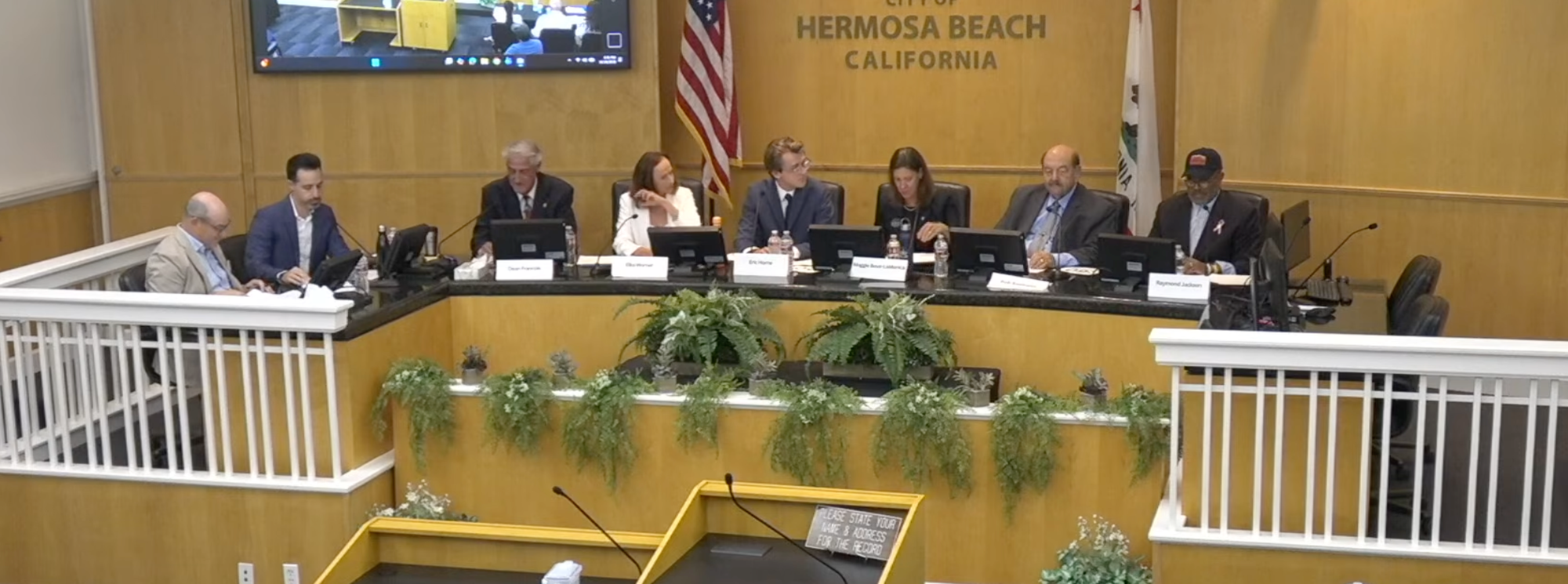
Councilmembers Dean Francois, Ray Jackson and Rob Saemann are seeking re-election against school board member Maggie Bove-LaMonica, Parks and Recreation Commissioner Elka Worner and nonprofit director Eric Horne. Three seats are on the Nov. 3 ballot.
The forum was sponsored by Leadership Hermosa Beach and moderated by Paul Reiner and Ashkan Zakir, who said they wanted to go beyond the two earlier debates and press candidates on how they make decisions and which tradeoffs they would accept. Candidates answered 13 questions and could use a limited number of 30- and 60-second response cards to rebut one another, which they did often.
Asked how they would balance the budget if the half-cent sales tax fails, five candidates said they support the measure. Francois again said he was "the only council member that's against it."
"Vote it on once, vote it on twice, it'll come up a third time, probably won't pass," Francois said. He said the council had already cut highly paid top management positions and called warnings about rising county lifeguard and beach maintenance costs "fear-mongering."
Horne listed cuts he said would save about $700,000 a year, including $370,000 in police overtime through data-driven scheduling, AI prescreening of building permits before they go to outside plan checkers, and $50,000 in landscaping. He said he would protect public safety and road and sidewalk funding.
Worner called for fewer consultants, more use of technology, shared services with neighboring cities and a hiring freeze on nonessential positions. She noted the city saved $1 million in 2011 by cutting firefighters per truck from five to four and asked whether similar measures could be revisited.
Bove-LaMonica, a signer of the ballot measure, said the council has not shown residents how the money would be spent and said she would dedicate a portion to street paving and potholes. If it fails, she said, the city should pursue a hotel tax in the next election cycle and an independent audit of staffing and spending.
Saemann said the budget is "fluid" and that naming specific cuts now would be impossible. He favored repeating this year's approach of percentage cuts across departments rather than eliminating any one of them. "Cut a little off of everybody," he said, while seeking revenue from hotel taxes, including back taxes on short-term rentals.
Jackson said the half-cent tax would raise about $2 million a year and that the 2024 three-quarter-cent measure he supported would have brought in $6 million by now. Either way, he said, the city has a structural deficit and needs frequent, open budget conversations with residents starting in January.
Worner asked why Jackson, who has sat on the council's finance subcommittee since 2021, had not raised a red flag sooner. Jackson sidestepped the question, but replied that Worner "was part of the effort to defeat the last tax measure," which he said cost the city $6 million. Francois said the pier and city yard would be funded through bonds and grants, not the general fund.
The longest exchange came over short-term rentals, which the city must now allow across the coastal zone after a court overturned its ban in March. The council majority voted to gather data before writing new rules.
Horne said he would reverse that pause and begin hearings now. He proposed a citywide cap, block-by-block density limits, a surcharge tax, dedicated code enforcement and a two-year bar on a rental license for owners who evict a tenant for a gut renovation.
Bove-LaMonica said Manhattan Beach held seven public hearings before deciding its policy and Hermosa held none. She said 4% of coastal-zone housing has already become short-term rentals, more than in Manhattan Beach or Newport Beach, and called Saemann, a former planning commissioner, "the architect of the plan that got us into the lawsuit."
"I've yet to meet a single resident who said, I want a short-term rental next to me," Jackson said.
Francois again called the opposing argument "fear-mongering" and said the Coastal Commission requires the city to gather citywide data first. He said he backed a six-month timeline over longer proposals and opposed rent control.
"I think we all want the same things. Safe, quiet neighborhoods," Worner said. She said she understands concerns about party houses, but that "we should make policy based on evidence and data. And we don't have that yet." She asked what the city would regulate without knowing how many short-term rentals exist, estimating there are about 50, and said Manhattan Beach's 2022 court loss should have been a warning sign to Hermosa.
Worner also said visiting volleyball families prefer rentals to hotels and that about a dozen landlords told her they have no interest in converting. "Where is the evidence?" she asked of Jackson's claims about evictions.
The candidates also disagreed over the city's earlier application to the Coastal Commission. Saemann said it was rejected as incomplete for lack of local data. Jackson simply said that it was withdrawn.
Asked whether to allow housing in the M-1 (Cypress Ave.) Arts District, Saemann said "absolutely," proposing a smaller arts district with the rest potentially opened to housing. Bove-LaMonica said she opposed housing there and wants to protect the area's galleries and character. Worner and Francois supported tasteful mixed use, with Worner preferring that new housing go on busier corridors like PCH and Aviation. Jackson backed "smart infill," including container homes on existing buildings.
Horne said the city's housing element counts the newly renovated Trader Joe's site toward 40 low-income units, and claimed that they "will never be built", leaving the city exposed to the kind of lawsuit Redondo Beach lost. He said the Arts District could supply replacement sites.
Saemann gave the evening's most pointed answer on whether to renovate, relocate or defer work on City Hall. He recalled the council's first meeting with a consultant the city paid "hundreds of thousands of dollars" to recommend tearing the building down, either to rebuild on site or to put a hotel there and move City Hall near the community center.
"I was the first person to say, that is baloney, there's nothing wrong with this building, we can fix this building," Saemann said. "I've been a contractor for 50 years and I know what I'm talking about." Responding to Bove-LaMonica's claims of leaking buildings, he said the courtyard leak has been fixed. "If there's a leak on the police department, why don't we get a roofer out here and fix the leak, for crying out loud," he said. With proper repairs, he said, the building could last "another decade or two or three."
Using a response card, Saemann said the city manager's advisory group spent months studying the question and "came up with exactly the same answer I came up with in the first five minutes."
Horne, who served on that advisory group, said it could not make a recommendation without far more analysis and that the problems are real: the police evidence locker has leaked and female officers use a locker room in a hallway. Jackson and Worner put City Hall at the bottom of the priority list, and Francois credited himself with stopping plans for a new civic center.
On shared services, Worner, Bove-LaMonica and Saemann raised sharing Redondo Beach's city yard, with Saemann later saying he meant only during Hermosa's re-construction of its own. All six said the city should keep its own police department. Saemann and Worner both advanced the potential for the City to move Fire service provision from LA County over to Redondo Beach in the face of a potentially huge contract cost increase.
All six voiced some support for the privately funded dog park proposed by Bark for a Park. Jackson (who has previously advocated against the Valley Park location) suggested piloting off-leash hours at Valley Park in the meantime. On artificial intelligence, most candidates pointed to faster permitting. Horne said he would bar AI from police drones, surveillance and facial recognition. Francois proposed using AI for press releases and eliminating the public information officer.
In the closing question, moderators asked what candidates would want voters to judge them on at the end of a term.
Horne named short-term rental rules approved by the Coastal Commission and a balanced budget with a funding path for the pier and city yard. Bove-LaMonica listed a budget reset tied to a one- to three-year strategic plan, a public dashboard tracking spending, paving and public safety, and a pier plan.
Saemann said he wants neighborhoods "free of state mandates," a new pier, a revenue-generating project on Parking Lot A underway and "a city council without arguing and bickering about small things." Jackson said curing the structural deficit is "priority numero uno," followed by short-term rental rules he said his Coastal Commission work could help deliver and county, state and federal money for the pier.
Francois said he wants pier funding from grants and bonds rather than taxpayers and a business-friendly city that thrives "without passing a sales tax."
Worner closed the evening. "In four years I want Hermosa Beach to still feel like Hermosa," she said. "A safe, vibrant beach town with a thriving local economy, beautiful parks and beaches." She said she wants a revitalized pier, neighborhoods that "haven't lost their character" and a less divided council, where members "can disagree without becoming enemies and treat each other with respect" and "really get things done for the residents." "And I think we can achieve that," she said.

Election season moves into full swing with the first candidate debate last night.

The Parks and Recreation Advisory Commission voted Tuesday night to form an ad hoc pool subcommittee, on a tight mandate and a six-month clock. Neighboring cities' pool projects, and Hermosa Beach's own dog park campaign, tell us that the real work is all still to be done.

Tuesday night's City Council meeting had a bit of everything: a heartfelt tribute to one of Hermosa's most familiar civic voices, a long-simmering fight over vacation rentals that finally came to a head, and a feel-good update from a beloved local club celebrating its 90th year.

Facing a budget hole that could hit $4.2 million, Hermosa Beach is turning to the very thing it spent a decade banning: short-term rentals
By Hermosa, for Hermosa. Join The Review today.