The Parks and Recreation Advisory Commission voted Tuesday night to form an ad hoc pool subcommittee, on a tight mandate and a six-month clock. Neighboring cities' pool projects, and Hermosa Beach's own dog park campaign, tell us that the real work is all still to be done.
Tuesday night's City Council meeting had a bit of everything: a heartfelt tribute to one of Hermosa's most familiar civic voices, a long-simmering fight over vacation rentals that finally came to a head, and a feel-good update from a beloved local club celebrating its 90th year.
Council Sends 0.5% Sales Tax Hike to November Ballot
Hermosa Beach voters will decide in November whether to raise the local sales tax by a half cent — the city's third try in four years. The deciding vote came from Councilmember Ray Jackson, who called the measure a hope rather than a plan and then voted for it anyway.
The City Council voted 4-1 Tuesday night to ask voters in November to raise the local sales tax by a half cent, just reaching the four-vote supermajority state law requires — and doing so only after the swing member spent several minutes saying the city has no financial plan before voting yes anyway.
The measure, which the council designated Measure HB, would establish a half-percent local transactions and use tax on purchases within the city, generating an estimated $2 million a year. As a general tax it needs only a simple majority to pass in November, and the money would flow into the general fund without restriction. Councilmember Dean Francois cast the lone no vote.
It is the city's third attempt in four years. A three-quarter-cent measure failed in 2022, and a 2024 version — which included a 20-year sunset, annual audits and a citizen oversight committee — did worse.
Administrative Services Director Brandon Walker told the council the measure codifies direction given during June's budget adoption. He described a balanced budget for the coming fiscal year sitting in front of deficits projected to grow by $3 million to $4 million annually over the next four to five years, driven by county contract increases, capital needs and inflation.
The council closed a $3.2 million gap this cycle, Walker said, with $1.3 million in operational cuts, a downgraded human resources position, deferred vehicle purchases and contingency funds. "There's real teeth behind what we're doing," he said.
The largest single threat is the county's contracts for fire service, lifeguards and beach maintenance, which at full cost recovery would run about $5.5 million a year — $3.5 million of that for lifeguards alone. The city currently pays roughly $350,000 combined under an older agreement tied to a share of parking structure revenue. Neighboring cities pay nothing, because their beaches are county-owned and Hermosa Beach's is not.
Smaller pressures are stacking up behind it. The city's landscaping contractor has asked for a 30 percent increase just to maintain existing service.
Walker also presented survey results from an outside consultant: 94 percent of respondents rated their quality of life excellent or good, nearly 80 percent were satisfied with city services, and an initial ballot test showed 56 percent support, rising to 62 percent after supporting arguments and settling at 55 percent after opposing ones.
Just before the vote, Walker returned to the microphone with a caveat. "The survey did benchmark and test a full 1 percent sales tax measure. Here we're proposing a half percent," he said. "So it's not quite an apples to apples."
Public comment: prove you'll fight for it
Speakers spent less time on whether the tax was warranted than on whether the council would actually campaign for it.
Parks and Recreation Commissioner Barbara Ellman, speaking as a Loma Drive resident, called out members by name. To Francois: "You have run your campaign against tax increases." To Mayor Pro Tem Michael Keegan: "You are probably one of the main reasons why the last tax increase didn't pass. So what's changed, and what are you going to do to help us?"
"When the school board passed their bond measures, they walked. They wore silly outfits. They had signs," Ellman said. "I see you voting and I see you hoping, but I have no faith that most of you are going to do anything other than sit in a chair and hope that this passes. So prove me wrong, please."
Laura Pena said she had stayed neutral on the two previous measures but would take a position on this one — and drew a line. "My red line is a citizen oversight committee," she said. She also pressed the city to be explicit about the resulting rate: with a county measure already approved, she said, passage would push the local rate to 10.75 percent. "They don't want to find this out in an opposition campaign."
The debate
Councilmember Rob Saemann, who made the motion, opened by taking Ellman's challenge personally. "I have always been willing to speak to anybody who wants to speak to me, including you," he said. "You cannot make this decision based on, gosh, I wonder if this will be good for my campaign or not good for my campaign."
He conceded the $2 million won't solve the structural problem. "This tax money isn't going to build a new pier or a new city yard or any of that business," he said. "But this will help us with our deficit next year, for sure. And the year after that and the year after that." He acknowledged voters' distrust was earned: "Most of the people in the city believe that we wasted money on things. And I think we did."
Francois was unmoved. "It's failed twice. The voters have rejected it," he said, calling the tax regressive and pointing to alternatives the council passed on. "We had the opportunity to increase the hotel tax, paid for by visitors, not by residents... This council failed to elect to put that on the ballot." He also rejected the county contract premise outright: "We own the beach, but it's a county's responsibility for the health and safety and welfare of the county."
Keegan — the member Ellman blamed for the last defeat — came out for it, and with a plan. "When someone says we don't have a plan, I have a plan," he said. "We pass this sales tax. We allow short-term rentals in our coastal zone and collect $2 million a year." Add redevelopment of the two corners near the beach, he said, and "that will be $9 million in incremental money that we can bond on." Manhattan Beach, he noted, collects $1.7 million a year in bed tax in its coastal zone. He said he had opposed adding a hotel tax to this ballot because the city didn't want to confuse voters or lead the South Bay in tax rates.
Keegan also warned what a no vote buys. "The only way we'll save real money in our budget right now is to cut our policing staff," he said. "I'm not proposing it."
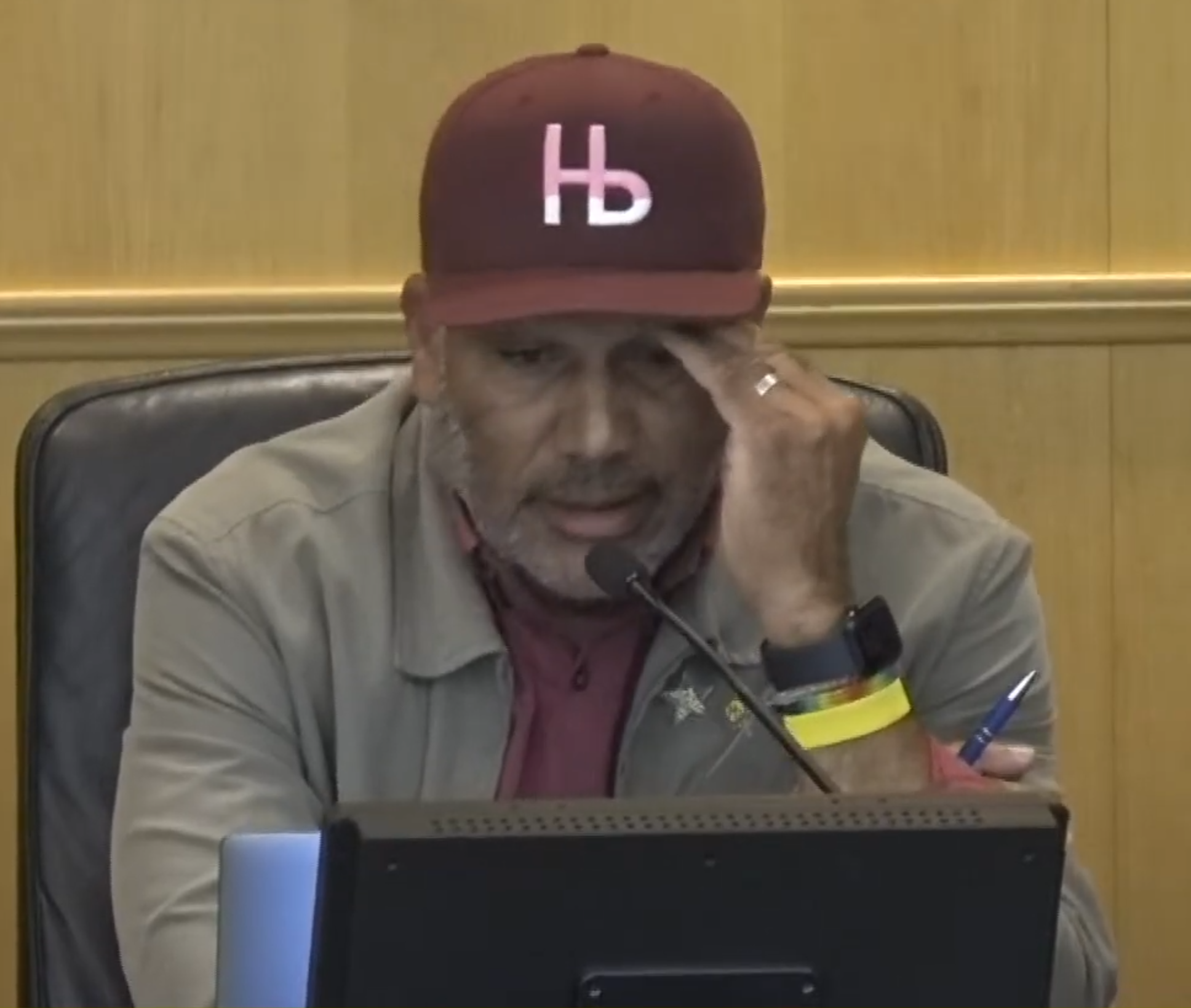
Jackson delivered the night's longest and most conflicted remarks, and did it as the acknowledged swing vote. "I guess I'm the swing, assuming Council Member Francois is still a no, but my concern is there's no plan," he said. "This ballot measure is just, okay, let's put it up there and hope. Hope, hope, hope. Hope is not a plan, hope is not a strategy."
The Man Without A Plan? Councilmember Raymond Jackson on Tuesday evening
Notably, Jackson offered no plan or suggestion of his own as to how he believes the city can tackle the fiscal cliff that it faces. In recent budget sessions, he has proposed a GoFundMe collection as the answer to the $53 million Pier rebuild, and placing parking meters on Monterey Blvd. and Manhattan Ave. to raise parking revenue.
The Parks and Recreation Advisory Commission voted Tuesday night to form an ad hoc pool subcommittee, on a tight mandate and a six-month clock. Neighboring cities' pool projects, and Hermosa Beach's own dog park campaign, tell us that the real work is all still to be done.
Tuesday night's City Council meeting had a bit of everything: a heartfelt tribute to one of Hermosa's most familiar civic voices, a long-simmering fight over vacation rentals that finally came to a head, and a feel-good update from a beloved local club celebrating its 90th year.
Hermosa Beach is making it easier to build condos. The Planning Commission voted Tuesday to drop a longstanding permit requirement and speed up approvals for smaller projects, following new state housing rules.