
What The Flock ?
A privacy overreach or an essential tool in modern policing ? The use of surveillance cameras in our city is in focus this week.
A privacy overreach or an essential tool in modern policing ? The use of surveillance cameras in our city is in focus this week.

Every car that drives into Hermosa Beach on its main streets passes at least one license plate reader. On Tuesday, the City Council heard exactly how many there are, who can see the data, and how long it is kept. What the police department could not say was how often the cameras help solve a crime.
"It's not something we're specifically tracking," Police Captain Eric Cahalan told the council.
The discussion comes as Flock Safety, the largest plate reader vendor, faces a national backlash. More than 50 cities and counties have dropped its cameras this year over privacy concerns and data-sharing lapses.
The Hermosa Beach Police Department runs 29 automated license plate reader (ALPR) cameras from four vendors. Ten Flock Safety cameras and four Vigilant cameras (owned by Motorola) are mounted at what the department calls "critical intersections." Twelve Axon cameras are fixed to patrol cars. Three Genetec cameras ride on parking enforcement vehicles.
Cahalan said the cameras take one still photo of each passing car. There is no video and no facial recognition.
"We don't see the picture," Cahalan said. "Nobody's sitting monitoring the camera systems to see which cars are driving through."
Photos with no connection to a crime are deleted automatically: after 30 days for Flock and Vigilant, and after 90 days for Axon and Genetec. "Hits" on vehicles reported stolen or wanted are kept for one year. In August, under growing scrutiny, Flock cut its recommended retention period to seven days, but existing customers like Hermosa Beach remain defaulted to the 30 day retention.
When a stolen car passes a camera, the regional dispatch center alerts officers. Before making a stop, officers must confirm the plate with dispatch against the state's Stolen Vehicle System. "Not enough just to get the hit from the camera," Cahalan said. "We don't do that. That's a little risky."
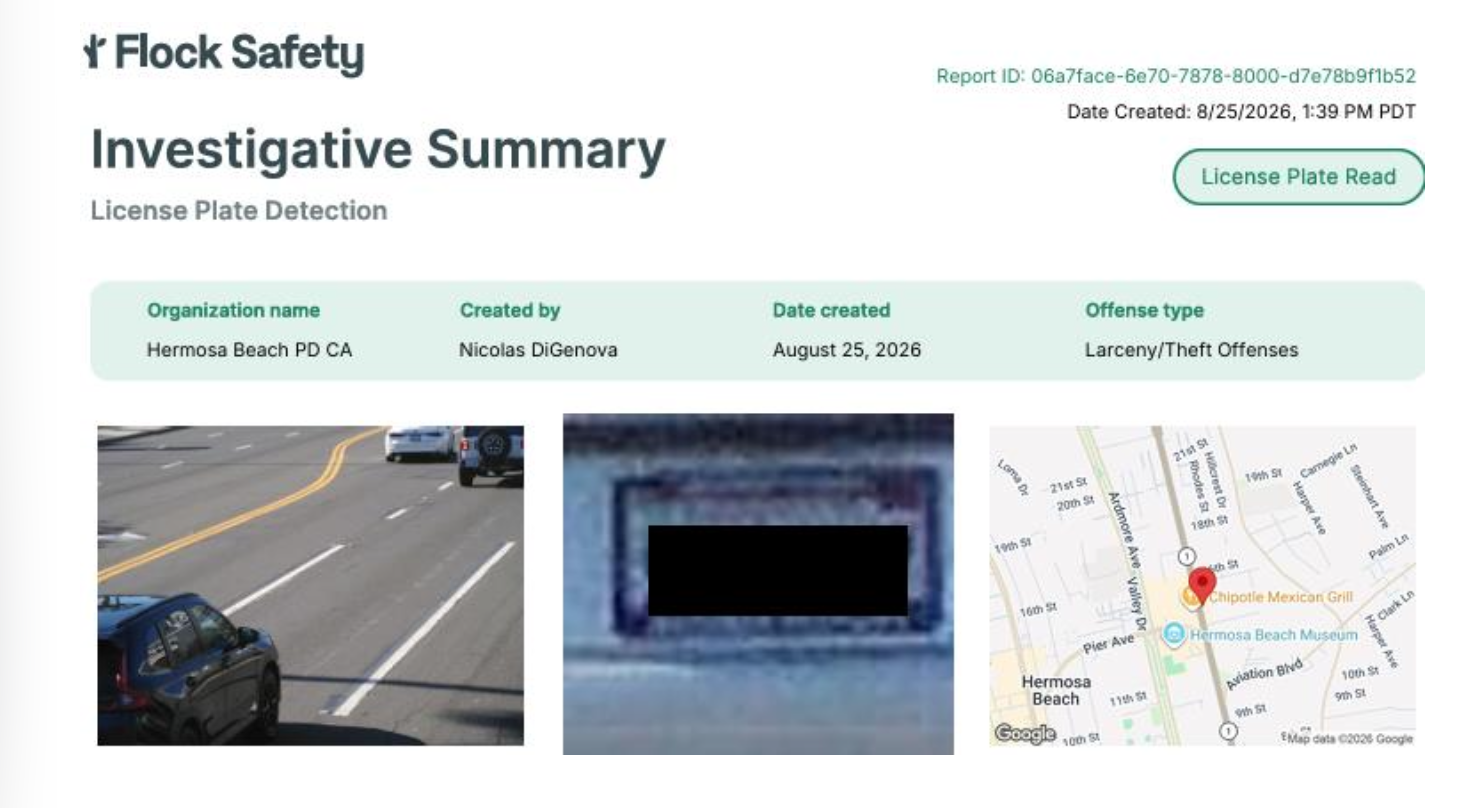
Department policy requires officers to enter a case number and an investigative reason for every search. "No officer can just log in and just start looking at plates," Cahalan said. An administrative lieutenant audits searches monthly, and the department reported "zero allegations of misuse."
Cahalan said most of the 14 fixed cameras are on PCH, Aviation Boulevard and Hermosa Avenue. Two are on Monterey and one is on Manhattan Avenue. Each is "near an intersection," though "they may not be exactly at an intersection."
Placement depends on which poles the city owns, Cahalan said. Most poles on the east side of town belong to Southern California Edison, and the department wanted to avoid Caltrans permits and trenching. Along PCH and on the west side, the city owns its light poles.
Criminals "like to leave undetected," Cahalan said, and a city with only a few north-south and east-west routes makes them easy to cover. "So driving down Hermosa Ave after committing a crime might not be the best way to go. So they might try to take Monterey."
"Crime is not specific to a commercial area," he added. "People live everywhere throughout the city."
Hermosa Beach shares its ALPR data with 84 California law enforcement agencies. Each has signed an agreement barring use of the data for immigration enforcement or reproductive health identification and forbidding sharing with federal agencies. California law already prohibits sharing ALPR data with federal or out-of-state agencies. According to the department's presentation, the administrative captain reviews sharing requests and "denies several requests each month."
The questioning showed where the city's control ends. That gap has caused problems elsewhere in California. In Ventura County this year, a vendor configuration error let out-of-state agencies run more than 364,000 searches against the Sheriff's Office's Flock data.
Council asked whether Hermosa Beach could control what a partner city does with the data once it has it.
"Now they could, we couldn't stop them," Cahalan said, using Gardena as an example of a partner city. "But the agreement is they won't share with the federal government."
Cahalan said a partner agency's own audits might catch a "bad actor," but conceded, "they may or may not."
"I think a lot of it just boils down to trust," the councilmember said.
Cahalan argued that sharing is the whole point. Without partners, "the camera system is only for our city, so it's not doing us any good," he said. "When we're victimized, it's from outside our community."
Asked about results, Cahalan described a recent vehicle break-in in which guns were stolen. Flock produced the first lead, a license plate, which led detectives to three suspects, all of whom were arrested. Cahalan said one of the stolen guns had been used in "a serious violent crime" in Los Angeles. A second gun was recovered.
"That's one out of numerous success stories," Cahalan said. "If for some reason it were to ever go away, we'd be back to the old days. Which, you know, is okay too. Just takes a lot longer."
City Council candidate Elka Worner asked the department to publish how many crimes had been solved, arrests made or stolen vehicles recovered with the cameras' help. She cited "concerns about privacy and cost."
Cahalan said those numbers do not exist. "How many cases do we solve where video was part of the lead? I mean, that's endless," he said. He offered to bring back "10 or 15" highlighted cases instead.
Councilmember Raymond Jackson asked whether the department could produce an annual report on cases investigated and solved using ALPR leads.
"Was it 20? Was it 200? Was it zero?" Jackson asked. "If we can't figure that out, then, I mean, this is 2026."
Cahalan said the department might "figure out a way" by working with its crime analyst.
When The Hermosa Review met with the department's crime analysts last year, they revealed the difficulties they face in compiling such statistics. The base system used to log data is over 20 years old, and lacks capability to automatically generate analysis of many incident types. They cannot for example identify e-bike incidents or the number of offenses involving transient individuals without manually sifting and counting. The same appears to be true for reporting the number of crimes solved using different types of camera technology.
Cahalan also answered the privacy concerns with a broader point about modern life. "We all continue to upgrade our phones. We log into the internet," he said. "So we're being tracked all day." Bad actors exist, he said, "and I hope they get caught," but "it's a small percentage."
"I tend to side on more is better," Councilmember Jackson said. "I like the Beverly Hills model, where they've got thousands of them. We had some issues in my neighborhood where I wish we had them."
Mayor Mike Detoy said he had brought the item forward after "going down the rabbit hole" of reporting on the Flock security flaw found by independent researcher Jon Gaines in 2025. Gaines showed that someone with physical access to a Flock camera could force it into a diagnostic mode and see its live view. Cahalan said the flaw affected single cameras, not Flock's cloud database, and that Flock has fixed it with a firmware update.
Plate readers are meant to be one part of something larger. In 2024, Rep. Ted Lieu secured $963,000 in federal funding for a Hermosa Beach Real Time Crime Center. It would bring the department's plate readers, surveillance cameras in areas such as Pier Plaza, and drones onto one platform.
"We are going to be able to bring all of these technologies together on one virtual platform," then-Chief Paul LeBaron said at the time. The city's capital budget still lists the project in the "conceptual planning phase."
The Real Time Crime Center did not come up on Tuesday. When it does, the council will face the same question on a larger scale: whether technology that lets a small department cover a city around the clock can be trusted, and whether the city can show that it works. It's not simply a question of catching criminals fleeing the scene of a crime - ALPR technology is also at the center of the City's plans to overhaul parking enforcement in order to increase fee revenue.
What are your feelings about surveillance technology in our city? An intrusion into personal privacy, or an important tool in effective modern policing? Let us know.
FURTHER READING
 Hermosa Review
 Hermosa Review

Second quarter serious crime stayed flat year over year, but cases of assault rose sharply. General trends remain downwards year-to-date.


Hermosa Beach police responded to 87 reported incidents during the two-week period of August 2-15, marked by a
By Hermosa, for Hermosa. Join The Review today.