Tuesday's agenda charts opposite paths for two sports at the same facility. Pickleball is poised for expanded access after a million-dollar renovation. Basketball hopes to rescue hoops removed after an unscheduled safety review
The police department is already running overtime patrols to assist with public safety concerns, including problems with e-bikes. Now council will decide whether to provide that effort with new resources.
Hermosa Beach faces a $548K budget shortfall at midyear, with projected spending increases vs. original forecast outpacing revenue gains 3-to-1. Staff proposes one-time funds to close the gap for the third straight year.
From Survival to Service: One Woman's Journey Through Homelessness.
A Harbor Interfaith outreach worker shares her story of childhood homelessness, addiction, and transformation.
On Thursday, Hermosa Beach will conduct its annual homeless count. It is part of a county wide effort to understand the scope of the homeless problem. According to last year’s count, there are between 15 and 30 unhoused people in Hermosa Beach. They live in tents, cars, and make-shift dwellings. Many are struggling and need support.
One homeless outreach worker, Valerie Campos of Harbor Interfaith Services, has made a real difference in our community.
Her work, and her achievements, inspired me to launch HB SAFE, a local outreach effort designed to connect the unhoused with vital services, improve public understanding of homelessness, and keep Hermosa Beach safe and welcoming for everyone.
This is Valerie's story.
Her Work
Valerie spends her days looking for people who don’t want to be found or helped.
She has helped dozens of homeless people find housing and worked tirelessly on two cases that illustrate the hardest edge of the homeless crisis: people classified as “service resistant” who repeatedly reject shelter, housing, and treatment.
“It can take a long time to convince someone to get housing,” Valerie said. “I just keep trying over and over again.”
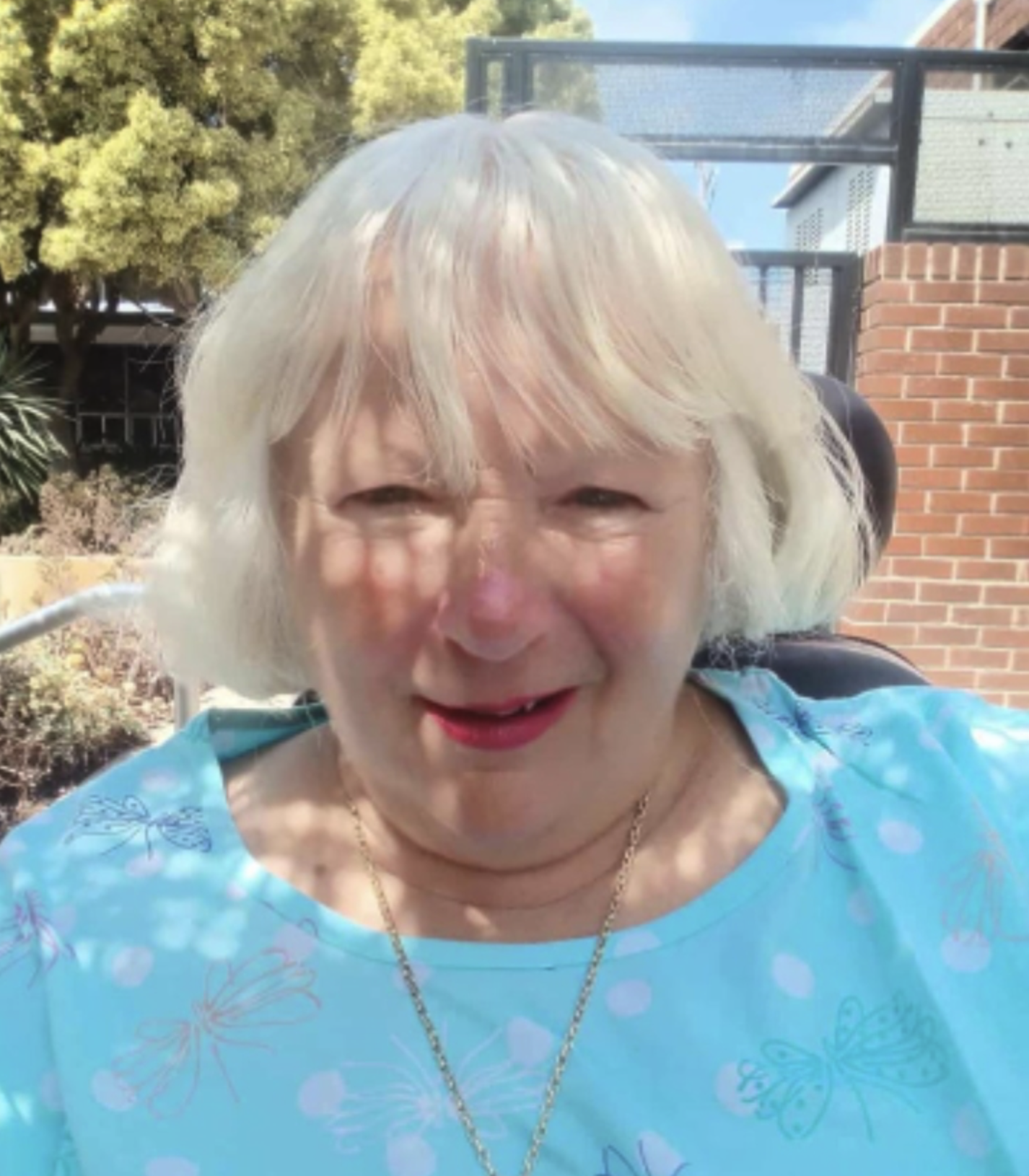
One of the women Valerie worked with, Denise (Dee), had been living on the streets for six years. She used a wheelchair and slept primarily outdoors, often positioning herself outside the Police Department, where she felt safest at night.
During the day, she rolled her wheelchair down Pier Avenue, recharging it at the library until it closed. Her life had a familiar cycle, brief motel stays, trips to the hospital for treatment of an infected leg, and a return to her spot outside City Hall.
Denise (Dee) was a familiar face in Hermosa Beach. She lived on the streets for six years, before finally moving into an apartment in San Pedro last month.
Denise (Dee) was a familiar face in Hermosa Beach. She lived on the streets for six years, before finally moving into an apartment in San Pedro last month.
Housing was offered five times. Denise turned down every option. She didn’t like the floors in one unit. Another had a broken elevator. Others were in locations she didn’t trust.
“I’m not going to shelters in Watts. I’m not going to them in Wilmington. I’m not going to them. They’re not going to help me,” she said. “There’s a lot of terrible characters down there. There’s people from jail down there. It’s not safe.”
Instead of giving up on Dee, Valerie persisted.
Dee finally accepted an apartment in San Pedro. But the placement stalled after paperwork was misplaced and county inspections delayed. The unit sat vacant for months while Dee remained on the streets. She finally moved in shortly before Christmas and credits Valerie for her good fortune.
“I really love her. I think she’s wonderful,” Dee said. “She cares about her clients. I think she goes all out.”
The second woman Valerie helped had been living in her car for nearly 20 years. Quynh (Queenie) moved between parking spots in north Hermosa, couch surfing and at times staying at a Buddhist temple. Like Dee, she was wary of services and reluctant to commit to housing. Valerie maintained regular contact, offered options without pressure, and eventually helped her secure permanent housing.
“I don’t think anybody really wants to be out there on the street,” Valerie said. “It’s a lonely feeling, watching everybody going to work, going to school, being a part of society.”
Valerie’s persistence was shaped by more than professional training. She understands homelessness because she has lived it.
Growing up, her family moved from motels to cars to living with relatives in East Los Angeles and Pasadena. She grew up in what she calls survival mode, a constant state of anxiety, always waiting for the next disruption.
“I just wanted routine so bad,” Valerie said. “I wanted structure so bad. I would see it on television, you know, the mom cooking, and we would have to cook for ourselves."
Her mother struggled with alcoholism and was “stressed out because she was the only one working,” Valerie said. Her father was depressed because he wasn’t the breadwinner in the family.
Valerie, her older sister and two younger brothers attended countless schools, never staying long enough to form lasting friendships.
“I never had people I grew up with,” she said.
The instability bred other problems. Valerie was infested with lice, which her mother failed to address. The other kids at her school screamed when they saw lice in her hair during choir practice. Her mom’s solution was to cut off her hair.
“I looked like a boy all my life,” Valerie said. “So that alone was just traumatizing for me.”
At 13, Valerie began running away from home. The relationship with her father was “very rocky.” She would escape out her window and hide with gang members in the area. One night, when she was sleeping in a garage, they tried to rape her.
“I kicked them off me. I don’t know how I got them off me. I was screaming,” she said. “This guy had his hand over my mouth, and I couldn’t breathe. They could have killed me that night.”
Because she was pulled out of school so often, Valerie couldn’t focus on her schoolwork. Her grades suffered, she was held back and eventually dropped out.
“I loved school. I really enjoyed learning and going to school, but I just couldn’t focus.”
Her Turning Point
After dropping out, she had no skills or formal education. She recalled seeing an ad for modeling that paid $1,000 a week. It turned out to be an escort service in downtown Los Angeles.
“You sit with these men and spend time with them like if you were at a club,” Valerie said. “It was a disgusting place.”
She left and became a dancer, traveling to different cities. In Las Vegas, she was human trafficked. Soon depression, suicidal thoughts, and alcoholism consumed her.
“I was very hopeless at the time.”
Her turning point came in a hotel bathroom. Homeless again, with nowhere to go, she cried out to God.
“I asked God if he was real, and I instantly was filled with the spirit,” she said.
Her brother had gotten sober at the Los Angeles Dream Center, so she knew exactly where to go. She checked herself into the Echo Park facility.
Valerie spent three and a half years there. No phone, TV, or radio her first year. She lived on campus, worked there, and studied the Bible for five hours a day.
She rose through the ranks to become an intake coordinator for women coming off the streets. She also did service work, going to Skid Row to hand out food, water, and prayer.
“I fell in love with being there for somebody,” she said. “Just letting them know they weren’t alone.”
When she left the program, the transition back to the real world was difficult. She started drinking again. Soon she was homeless again, this time sleeping on the beach in Redondo Beach.
“I was just crying, having nowhere to go,” Valerie said.
Out of options, she headed to the Redondo Beach Police station and pressed the intercom. Through tears she asked for someone she trusted, Lila Omura, from Harbor Interfaith, who had helped her brother years earlier.
That call changed everything.
With Harbor Interfaith’s help, Valerie was housed in a pallet shelter, enrolled in mental health services, found work.
She landed a job at Zale’s near the shelter and would dress up in heels, “looking like a million bucks.” She bought a car and moved into an apartment.
When a position opened at Harbor Interfaith, Valerie applied and was hired.
On Policy and Solutions
Her views on homeless policy have been shaped by her personal experiences and she is candid about what she thinks works and what doesn’t.
“There needs to be more attention on the mental health part of homelessness,” Valerie said. “More facilities. More mental outreach. More programs."
That perspective shapes how she thinks about Matthew, a homeless man who is familiar to many in town.
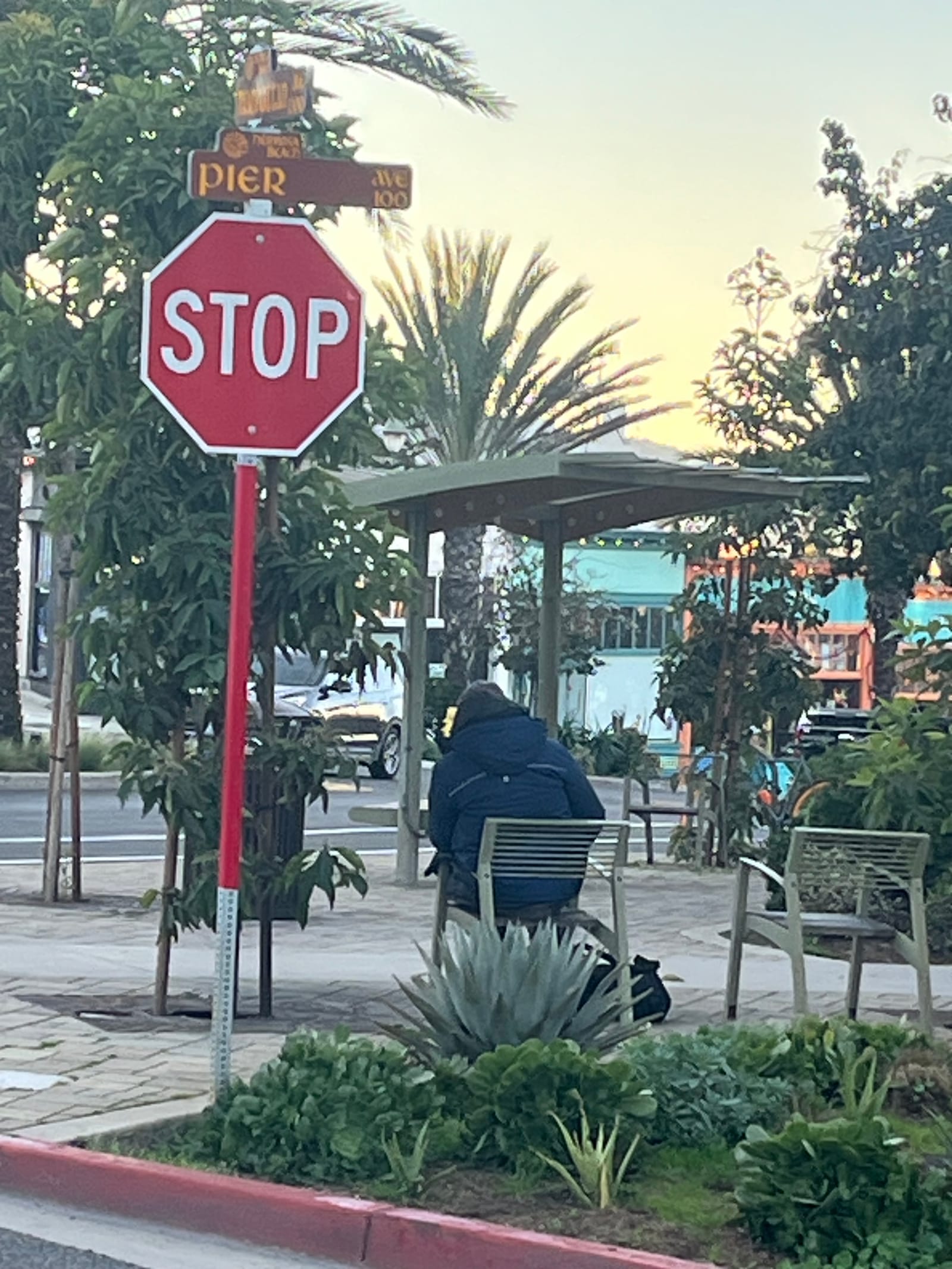
Matthew, in his regular spot on Pier Avenue
He has stood on the same corner for years, watched by a community who cares. People bring him food, money and sometimes clothes. Others stop to talk.
“It comes from a good place. People care,” Valerie said.
But caring, she has learned, doesn’t always mean helping.
“When someone’s been outside that long,” she explained, “they’re not really choosing that life anymore. They’re surviving it.”
Valerie doesn’t see Matthew as a fixture. She sees a man whose world has narrowed, days repeating, options shrinking, health deteriorating in plain sight.
“He deserves a bed,” she said. “He deserves a place where he can sleep and feel safe. A table where he can sit down and eat.”
She is conflicted about the food people bring him. “It keeps him alive. But if nobody was feeding him, he wouldn’t be able to feed himself.”
If the community weren’t enabling him, he might be more receptive to services, Valerie said. She believes Matthew should be under a doctor’s care, on court-ordered medication, living a better life, one with structure, treatment, and dignity.
“He doesn’t deserve to be on that corner all day, talking to himself.”
To those who argue that Matthew isn’t harming anyone and that this is where he wants to be, Valerie is direct.
“How do you know that’s where he wants to be?” she said. “I know it makes people feel good to help. But can you imagine if we could actually change his life?”
Valerie believes if outreach workers and programs like Harbor Interfaith had existed when she was a child, her life might have unfolded very differently.
“I would have had security,” she said. “I had no stability. I felt scared. I feared all my life.”
After decades spent in survival mode, Valerie finally understands what safety feels like.
“Now, I can get cozy,” she says softly.
All the individuals featured in this story gave permission for their names and photographs to be used.
Elka Worner is a community volunteer, City Commissioner, journalist, and Hermosa Beach local. She contributes occasional columns to The Hermosa Review, and publishes her own regular newsletter titled 'Elka's Update’ which you can subscribe to for free.
I’m Elka Worner, a community volunteer, City Commissioner, journalist, and Hermosa Beach local. I was raised here, and I’ve had the joy of raising my daughter in this amazing town.
Seventy-five years after its founding, Hermosa Beach Little League returned to Clark Field on Saturday with a record 570 players. Proud families cheered them on under a bright blue sky.
The Coastal Commission is quietly using building permits to force Hermosa Beach toward charging walk street and Strand homeowners annual fees for front yards they've maintained for generations. And finishing the city's Local Coastal Program is unlikely to save them.