

The Man Who Drew Hermosa
Exactly 125 years ago today, a kid from Ohio with nothing to do helped survey a town in the sand dunes. Hermosa Beach's 'First Citizen' never left.
Exactly 125 years ago today, a kid from Ohio with nothing to do helped survey a town in the sand dunes. Hermosa Beach's 'First Citizen' never left.

'Flying Bob' Reinbolt did not come to Hermosa Beach with a plan.
"I accidentally met the surveyor who had the contract to lay out the new town site of Hermosa Beach during the spring of 1901," Reinbolt told a local newspaper. "They were just preparing to start work, and, having nothing to do, I came along with them and helped them out."
He was 19 years old. He had come to Los Angeles from Fremont, Ohio. The place that would become Hermosa Beach was not yet Hermosa Beach. It was sand dunes, barley fields, a ranch house at the corner of Second and Camino Real, and not much else. B.H. Hiss had arrived with a grading outfit. A few structures were going up: the Morse & Morse building, the Pioneer building, a house belonging to a Mrs. Smith. The Hermosa Beach Land and Water Company, which had purchased 1,500 acres of beachfront the previous July at $35 an acre, needed someone to turn empty acreage into a town.
Reinbolt volunteered, and then he never stopped.
"The location looked good to me, and after the surveying was done I stayed right on with the Hermosa Beach Land and Water Co.," he said.
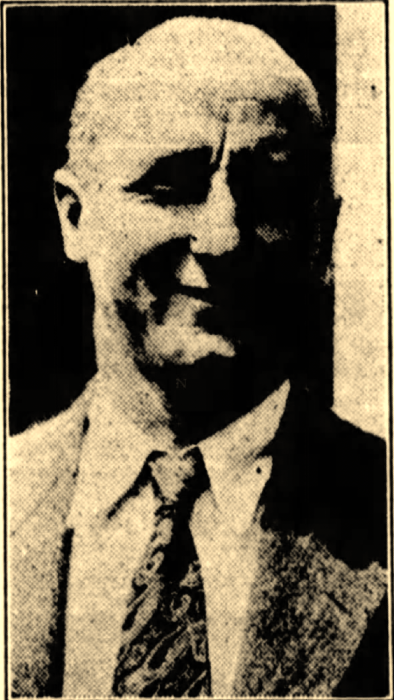
He stayed for nine years as superintendent, and for the rest of his life as a resident. His surveying crew laid out the bones of a city: Ocean Front Board Walk, now the Strand. Hermosa Avenue, the first paved street. Santa Fe Avenue, running east to meet the Atchison, Topeka and Santa Fe Railway tracks. They carved the land into building sites, subdivisions, and plots for water wells. According to the memory of his widow, Janette, the first water well was drilled at what is now 2nd Street and Pacific Coast Highway.
Reinbolt helped install the water system, the sewer system, and the gas mains. He mapped them all. "I secured a very complete knowledge of these systems and the location of the mains," he recalled. "In fact I made maps which are very useful to me." The knowledge proved bankable: he built a plumbing business that handled most of the principal buildings in town, including the new bank building and the Larson building.
In 1903, when the Pacific Electric Railway brought its big Red Cars through Hermosa, Reinbolt drove the first spike and oversaw the project. That same year, he organized the city's first baseball team and made himself captain.
On December 24, 1906, Hermosa held its incorporation vote. The tally: 24 yes, 23 no. Reinbolt voted yes. Because of his position with the Land and Water Company, he kept one of the two official copies of the count. The other went to Sacramento. The State of California approved the incorporation on January 2, 1907. By March, Reinbolt had been appointed the city's first Fire Chief, a post he held until 1923.
He was a charter member of the Chamber of Commerce in 1912, joined Kiwanis in 1926 and served as its president in 1931.
And then there was the car.
They called him "Flying Bob" because he owned the first known automobile in Hermosa Beach, and he drove it the way he did everything else: flat out. The local papers tracked his automotive misadventures with something between alarm and amusement.
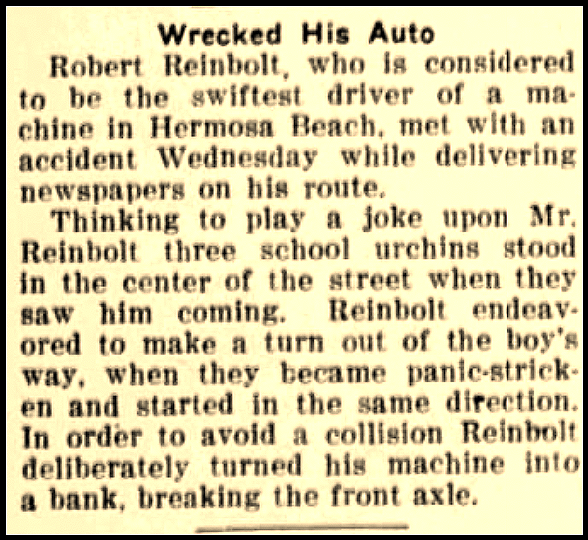
One report described him as "the swiftest driver of a machine in Hermosa Beach." On that occasion, three schoolboys stood in the middle of the street to play a joke on him. When Reinbolt swerved to miss them, the boys panicked and ran in the same direction. To avoid a collision, he deliberately turned his car into a bank embankment, breaking the front axle.
Another time, his car was struck by a southbound Pacific Electric trolley at 27th Street and Hermosa Avenue. The Red Car, obscured by the P.E. substation, hit the rear delivery box and threw it twenty feet down the track. Reinbolt and his passenger said they were going so fast they didn't feel the impact. The paper noted dryly that Reinbolt "seems to bear a charmed life," observing that about a year earlier the same car had rolled three times in the sand. He dug himself out unhurt and drove it back to the office under its own power.
On a rainy morning, he was rear-ended on Pier Avenue near Loma Drive while stopped to pick up a friend. The collision threw him against the seat and cab hard enough to twist his back and neck. He was taken to the Hermosa-Redondo hospital. His car, naturally, was driven away under its own power.
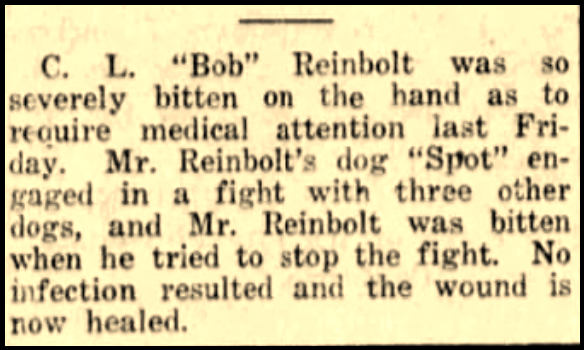
Even the dog got in on it. Reinbolt's dog Spot got into a fight with three other dogs. Reinbolt waded in to break it up and was bitten on the hand badly enough to require medical attention. No infection resulted.
Reinbolt once claimed that anyone who said they were the first settler in Hermosa Beach should be referred to him. "I can show by my records that I connected up their house to the water system," he said.
He watched the place grow from what he called "a waste of beach sand to the modern metropolitan city that it is today." He married Janette F. Smith in 1908. They had two sons, Evron and Elden, and Flying Bob spent 43 years in the town he surveyed into existence because he had nothing better to do on a spring day in 1901. The family home was at 1516 Monterey Blvd.
In October 1944, Reinbolt traveled to Elsinore on the advice of his physician. Heart complications developed. He rallied, was thought to be out of danger, then relapsed suddenly on a Saturday afternoon. He died that evening, on October 7, 1944, one day before his 65th birthday.
The Requiem Mass was celebrated at American Martyrs Catholic Church on Highland Avenue in Manhattan Beach. South Bay newspapers called him Hermosa's "first citizen." He was buried at Holy Cross Cemetery.
Today, 125 years after Reinbolt helped lay the first stakes, streets in Hermosa Beach still follow the lines he drew. The Strand. Hermosa Avenue. Pier Avenue. The grid of the city that we all call home began as pencil marks on a teenage surveyor's map. The sand dunes are gone. The barley fields are gone. Flying Bob is gone. But the lines hold.

If you enjoyed this little piece of Hermosa history and you aren't a subscriber yet, just take a moment to sign up. It's completely free, and lets you access all our content, plus weekly newsletters and more. 100% Hermosa news and views, 100% ad-free.
Join the Review today

Restoration, dedication, celebration. Mural 're-unveiling' sets the scene for Hermosa history in a special birthday week.

Pier Plaza mural has been restored and updated with some new additions to be unveiled on Jan 10th

It's about more than just the tree. Much more.

Some Thanksgiving bargains from this week in Hermosa 60 years ago. What do you remember ?
By Hermosa, for Hermosa. Join The Review today.