

City Council Eases Land Value Recapture Fees, Aims to Spur Downtown Development
Council supports Planning Commission decision to backtrack on 'failed experiment'
Mayor follows up his recent State of the City event with a wide-ranging Q&A discussion

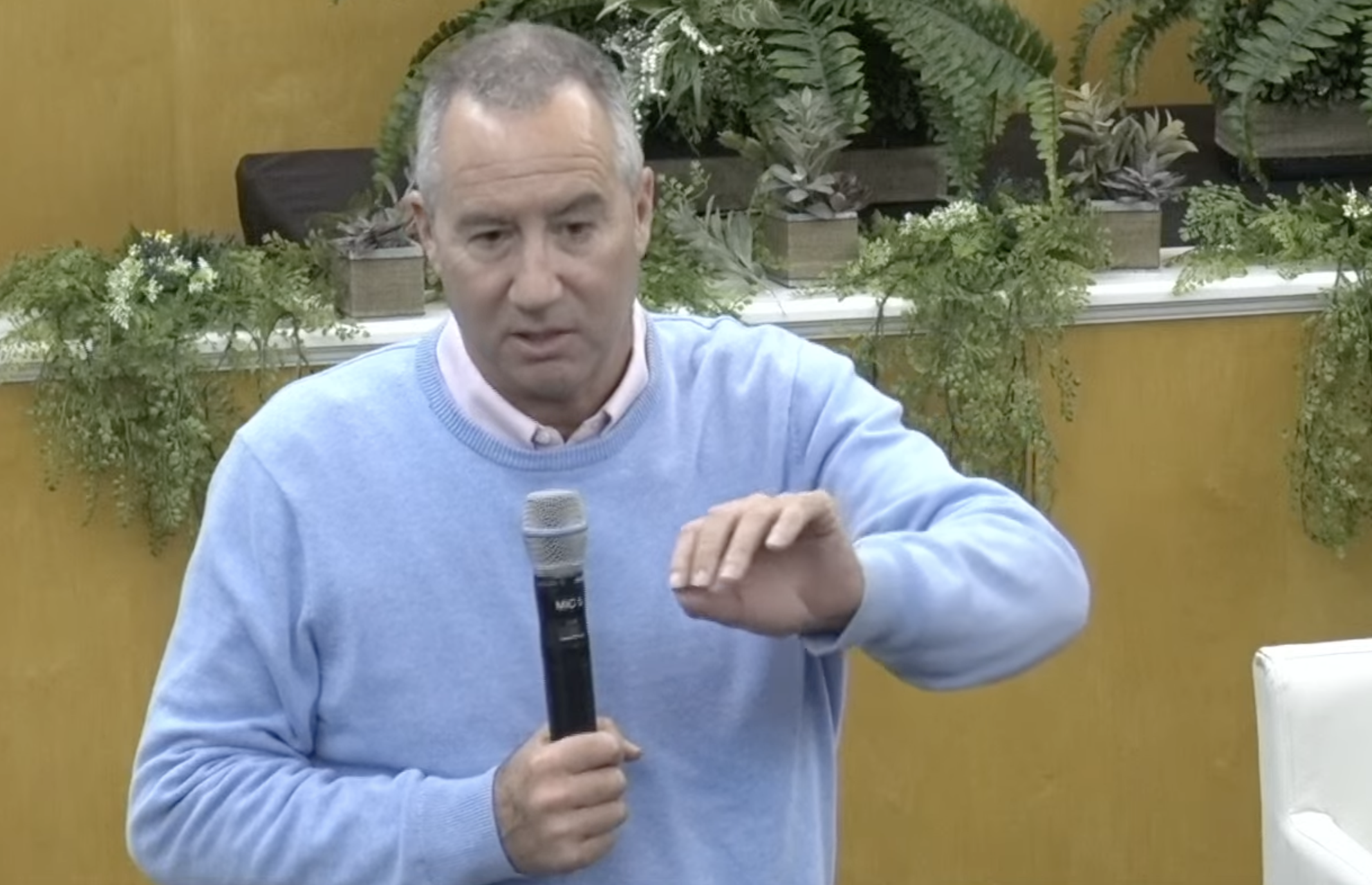
Mayor Rob Saemann hosted a comprehensive town hall forum Thursday evening, addressing community questions ranging from e-bike enforcement to business development, city infrastructure projects, and immigration enforcement policy. The two-hour session followed up on questions submitted at the recent State of the City address.
E-bike safety emerged as the evening's most prominent theme. Mayor Saemann acknowledged the city currently lacks authority to require license plates on e-bikes but expressed strong support for pursuing state legislation through the South Bay Council of City Governments.
The mayor proposed using contract officers to enforce existing regulations on the Strand and Plaza, noting he personally observed approximately 15 violations during a 10-minute period on the Plaza that afternoon. "If we had contract officers that could be there, those people all would have gotten tickets," he explained. Saemann has taken a lead on city council in recent months in advocating for a pilot program to explore the use of contract officers.
Police Chief Landon Phillips confirmed the department has issued hundreds of citations and impounded dozens of e-bikes since the urgency ordinance passed in June. "There's no magic bullet that's going to solve this immediately, but we will continue to enforce," Phillips said.
Responding to business owner Gina Rothwell's concerns about downtown vacancies and foot traffic, Saemann outlined several initiatives. The city employs a liaison officer to help businesses navigate permit processes, and City Manager Steve Napolitano has been meeting with property owners to "kick-start revitalization."
Community Development Director Alison Becker has implemented significant improvements since joining in May 2025, Saemann said. The department is finalizing its implementation of Accela, an electronic permitting system allowing online submission, payment, and tracking.
The city also implemented a self-certification process for minor tenant improvements, allowing licensed architects or engineers to certify plans meet code requirements and submit them directly for permit issuance. Additionally, the city reduced regulatory review of alcohol-serving businesses with no complaints, eliminating unnecessary Planning Commission hearings.
The city yard facility at 6th Street emerged as a major priority. Saemann described the aging facility as "old and tired and dilapidated" but emphasized its critical importance to city operations. The city has hired a construction manager to assess the facility and guide the project.
City Manager Napolitano explained the project will be funded through new parking revenue without drawing from the general fund. The city is in "maintenance mode" on City Hall, focusing on necessary improvements while prioritizing the city yard project.
Saemann broke down the $3.6 million in new revenue: $2.5 million from increased parking meter rates, $800,000 from parking citation rates, $200,000 from eliminating the deputy city manager position, and $200,000 from eliminating consultant contracts.
He emphasized this revenue prevents city yard bond payments from competing with core services but does not eliminate the structural deficit. "Addressing that imbalance still requires separate ongoing actions," the mayor said.
Responding to concerns about potential ICE operations, Saemann read the city's official policy: "HBPD does not enforce immigration laws. We do not stop or detain people for the purposes of immigration enforcement. If any federal agency is in our city limits conducting federal law enforcement business, we will not interfere or obstruct them in doing so."
The mayor added, "I think that's fairly clear. I think that's a reasonable policy that we're not going to help enforce immigration laws. That's not our job. It's not the police department's job. But we're here to protect our people in the meantime."
Saemann expressed confidence in the police department's handling of any situation that might arise: "I have great confidence in our chief and our department that they'll handle it properly and that our citizens will be safe and that whatever the federal officers are doing, as long as it's legal, they'll be able to do that unimpeded by our police department."
Zoom participant Tony Higgins criticized the council's approval of a second Labor Day fiesta event. He expressed frustration that the Chamber had announced that they would make $350,000 in profit from the fiesta events but announced it will no longer contribute St. Patrick's Day parade profits to community causes.
Saemann confirmed he was the sole vote against approving the second fiesta, having proposed adding a beer garden to the St. Patrick's Day parade to generate shared profits between the city and Chamber. "If the city is going to pay for these things and pony up money for these events, then we should share in the profits," Saemann explained.
Local planning expert Stacy Straus from Srour & Associates praised the cultural shift under Napolitano's leadership:
"I have seen a tremendous change overall in the whole city with Steve's presence, and the culture is significantly different and so very much appreciated."
She requested that staff hold a dedicated community development forum for detailed feedback.
"Hermosa means business," Napolitano said. "Our first answer should not be no."
Napolitano cited a recent example of this collaborative approach: "I sat down with a lot of different business owners working on different projects. Most recently, I sat down with the new owner of the laundromat down on the south end of town on Hermosa Avenue, and she had a few issues, wanted to come in, talk, so I made time, brought in Alison. We went over what her needs were, how we can address those, and she was very happy with the outcome."
He acknowledged ongoing challenges while emphasizing the commitment to improvement: "As Rob said, it is not perfect. It's never going to be perfect. You're dealing with processes, people, and interpretations, but we're going to work on those, and our first answer isn't going to be no. It's going to be, okay, let's see if we can find a solution for this."
Saemann closed the meeting by emphasizing the importance of ongoing community dialogue: "We've got to keep this up. We have to keep talking to each other to make this a better city."

Council supports Planning Commission decision to backtrack on 'failed experiment'

Decision postponed on patio encroachment fees as residents urge support for iconic Hermosa businesses

Homeless update, Outdoor seating fees and controversial developer fee program all on the agenda, together with beach vendor proposals

By Hermosa, for Hermosa. Join The Review today.