

History Restored: Centennial Mural Unveiled on Glorious Hermosa Morning
Restoration, dedication, celebration. Mural 're-unveiling' sets the scene for Hermosa history in a special birthday week.

Tamit the Tongva 'sun god' most definitely blessed the city this weekend. Under brilliant January skies, Hermosa Beach gathered Saturday morning to witness the unveiling of a restored tribute to the city's history, a 40-foot mural that blends community memory with artistic renewal.
The ceremony on Pier Plaza marked both the Hermosa Beach Kiwanis Club's 100th anniversary and the return of the Centennial Mural, originally created in 2007 but weathered by nearly two decades of coastal elements. It coincides with Hermosa's 119th 'birthday', incorporated as a city on 14th January 1907.
VIDEO : Watch the moment the mural was unveiled
"This day has been a long time coming for us," said Chris Miller, author of two books on Hermosa Beach history and a driving force behind the restoration project. Miller, daughter of Warren Miller who brought the family to Hermosa over 60 years ago and established his film business at 505 Pier Avenue, led the mural team alongside Kiwanis lieutenant governor Rick Koenig.
Artist Dawn Whitney-Hall, who created the original 2007 mural with her ex-husband Neal Von Flue, returned for the restoration with considerably more time to work. Where the first version was completed in perhaps eight weeks ("kind of a rush job," she said) this time she had about five months to plan and create.
"I had the time to give it a little more headspace," Whitney-Hall said. She also benefited from nearly two decades of artistic maturity and improved internet resources for finding historical imagery, resulting in compositional changes from the original.
The restored artwork features 118 distinct components spanning the city's evolution in a timeline format, moving left to right from the Tongva people through successive eras of Hermosa history.
Whitney-Hall worked on three panels at a time in the old Warner film studios in San Pedro, swapping them out as each was completed. She hadn't seen the full 10-panel mural assembled until a recent signing party.
"Everybody was standing there with their hands over their mouths," she recalled. "That's the best reaction I could possibly have. My hand was over my mouth too."
The mural includes nods to key moments and symbols: the Red Cars that once ran through the city, legendary 1950s surfer Dewey Weber, and even Colonel Duncan's pirate ship (a playful reference to both a street name and the city's "salty" character). Whitney-Hall admitted that "there's a lot of little 'easter eggs' in there for people to spot."
Annie Seawright, the five-time champion of the Hermosa Beach Ironman (a July 4th tradition of running a mile on the beach, paddling a mile in the ocean, and downing a six-pack of beer) appears in a portrait on the far right of the mural. She was absent from Saturday's ceremony as her daughter Piper, Roy Seawright's great-granddaughter, was running a 50-mile race on Catalina Island, with the entire family there to cheer her on. Hermosa's circle of life continues to turn.
Miller's remarks at the unveiling wove together threads of local history, recalling conversations with Howard Rumsey, the legendary Lighthouse manager who helped birth the West Coast Jazz movement, and Bob Hare, who ran the Insomniac Cafe and the Either/Or bookstore.
She recalled meeting Ted Kerwin, one of eleven siblings in the Kerwin family who opened their bakery in 1910 (now the site of Palmilla restaurant). Many of the Kerwins became the city's first lifeguards and were part of the early Hermosa Surfing Club.
Among those in attendance were members of founding families whose legacies appear on the mural. The MacFaden family, who organized Fourth of July celebrations complete with hourly cannon fire, joined Barb Guild, whose husband's family opened their first drugstore in 1936. Jim Lindberg, lead singer of Pennywise, represented Hermosa's punk rock heritage.
"Our history lives and breathes and grows everyday," Miller told the crowd. "We are fortunate to have many of the original buildings still standing and the families who built this town still living among us."
Rick Koenig, Kiwanis lieutenant governor who spearheaded both the original 2007 mural and this restoration, spoke to the power of public art in community life.
"A mural doesn't just decorate a wall, it tells a story," Koenig said. "It becomes part of the daily life of a city. People pass by it on their way to work, to school, to the beach, and back home again. Over time, it becomes a familiar landmark, a source of pride, and a reflection of who we are."
He noted that such projects happen "because people care. They happen because artists share their vision, volunteers give their time, sponsors provide support, and community leaders believe in the value of public spaces that inspire, educate, and bring people together."
Koenig said the mural represents the spirit of Hermosa Beach: "its history, its creativity, its people, and its sense of community."
Mayor Rob Saemann, who also serves as president of the Kiwanis Club, spoke of the unique convergence of anniversaries.
"As Mayor of Hermosa Beach, it is an incredible honor to stand before you during such a meaningful year," Saemann said. "Our city is celebrating 118 years, and at the same time, the Hermosa Beach Kiwanis Club is celebrating 100 years of service to this community."
"For 18 years, this mural has watched over Hermosa Beach. It has seen sunsets and storms, laughter and reflection, residents and visitors alike. It has looked out over an ever-changing shoreline and an ever-growing community, capturing the magic of a place that is truly one of a kind. Thank you to everyone who makes this city special. Thank you to our volunteers, our residents, our partners, and our families. Together, we honor our past, celebrate our present, and confidently step into the future."
MAYOR ROB SAEMANN
Looking ahead, Saemann emphasized the ongoing commitment to service. "As Kiwanis begins its next 100 years, our commitment remains clear: to serve, to lead, and to ensure that Hermosa Beach continues to thrive, not just for today, but for decades to come." It's a busy week for the mayor, as he also prepares to deliver his State of the City address on Thursday evening.
PHOTO GALLERY
The original mural, which had "the best view in town, watching everybody on The Strand, getting sunlight every day," Koenig said, ultimately fell victim to those same sun rays. Even the best materials fade, crack and peel, and no maintenance budget had been allocated 18 years ago. Eventually, commissioning a new mural proved more cost-effective than repairing the damaged original.
"I am very pleased with its vibrant portrayal of our history," Koenig said of the completed work. As such a small beach community, he noted, "a lot of people don't even realize just how much history there is here."
The project faced literal headwinds. The installation crew survived gale-force winds in the week before the unveiling. Miller thanked the entire installation crew for their support.
Miller announced the launch of hermosamural.com, a website that will provide background on each of the mural's 118 components. Attendees received postcards with QR codes linking to the site.
"We see this as a giant anniversary card to the City of Hermosa Beach we all love and cherish," Miller concluded.
Before the unveiling, both Koenig and Mayor Saemann rallied the crowd for a countdown to reveal the restored artwork.
The celebration included a flyover by a formation of historic planes, adding a dramatic flourish to the morning's festivities.
The Kiwanis Club, established in Hermosa Beach in 1926, funded the restoration through private donations, repeating the fundraising approach used for the original 2007 installation.
A LOOK AT THE DETAILS
(Reproduced with the kind permission of Chris Miller)
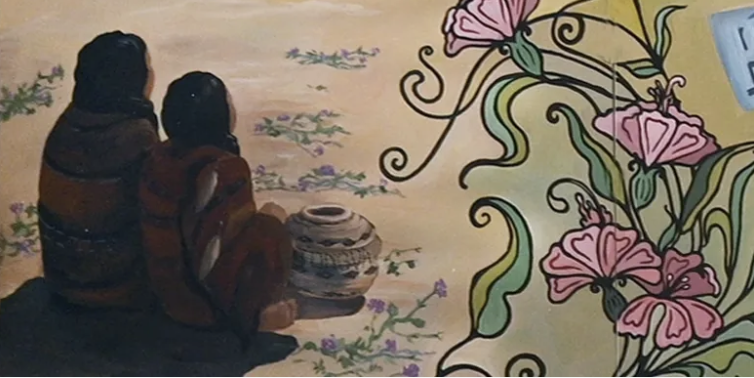
Tongva/Gabrielano Indians (click to read more)
The Tongva (/ˈtɒŋvə/ TONG-və) are an Indigenous people of California .
Tongva is the most widely circulated endonym among the people, used by Narcisa Higuera in 1905 to refer to inhabitants in the vicinity of Mission San Gabriel. Some people who identify as direct lineal descendants of the people advocate the use of their ancestral name Kizh as an endonym.
The Tongva, along with neighboring groups such as the Chumash, played an important role in the cultural and economic dynamics of the region at the time of European encounter. They had developed an extensive trade network through te'aats (plank-built boats). Their food and material culture was based on an Indigenous worldview that positioned humans as one strand in a web of life (as expressed in their creation stories). Over time, different communities came to speak distinct dialects of the Tongva language, part of the Takic subgroup of the Uto-Aztecan language family. There may have been five or more such languages (three on the southernmost Channel Islands and at least two on the mainland)

Shakespeare Beach (click to read more)
Shakespeare Beach was located at the city's northern border with Manhattan Beach, where the Pacific Electric Red Car Line came into the city. When the Shakespeare Tract was divided into parcels,the streets that were created were named after noteworthy English poets and writers. Such as Homer , Longfellow, and Tennyson, to name a few. This was an attempt to create an artists colony in Hermosa Beach.
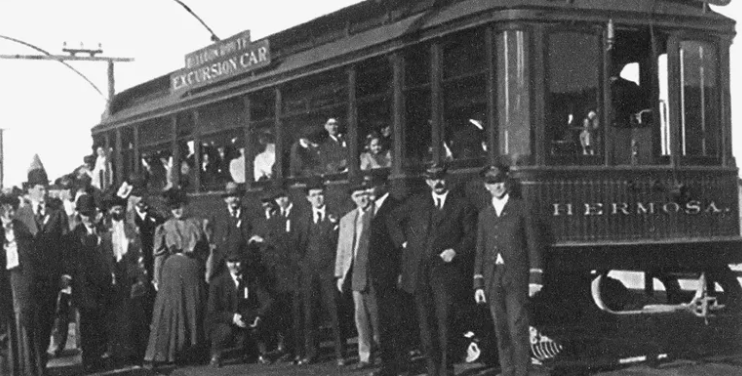
Pacific Electric Red Car (click to read more)
The Pacific Electric Car Line ran parallel to the beach down from Marina del Rey, past Playa del Rey, through El Segundo to Manhattan, Hermosa and Redondo Beaches. It was a favorite mode of transportation for the Los Angeles and Hollywood crowds to get to the big resort of Redondo Beach.In 1914, Pacific Electric laid stronger rails for bigger trains. The tracks dividing the northbound and south bound lanes of Hermosa Avenue were pulled out in 1941.
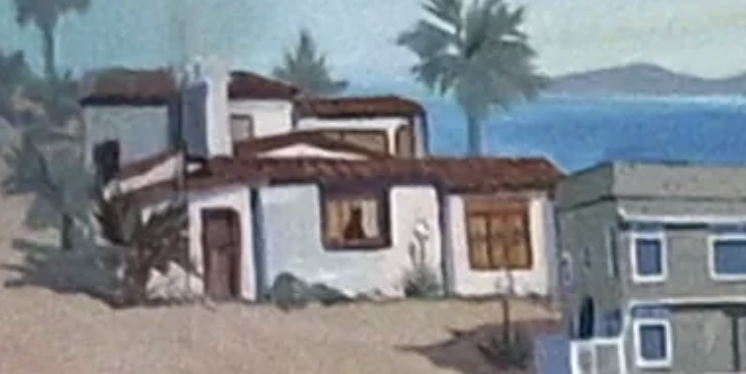
The MacFaden Family Home (click to read more)
John R. and Moya L. MacFaden had seven children.
The house at 3301 Strand in Hermosa Beach hosted friends of the children, extended family, dignitaries both local and international. The house was rarely quiet.
John R. was a big personality. He and Moya loved to entertain. Throwing numerous parties including the 4th of July parade which included a cannon being shot off every hour on the hour from 8AM to 8PM.
John R. graduated from Redondo Union High School in 1927. He was instrumental in bringing the Olympics back to Los Angeles in 1984.
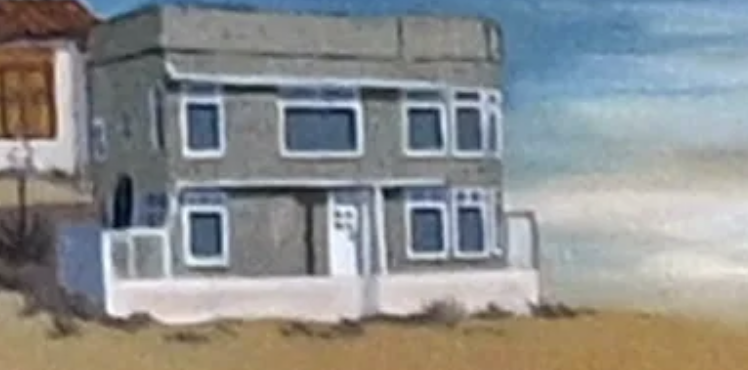
The Miller Family Home (click to read more)
Warren and Dottie Miller based his film company Warren Miller Productions at 505 Pier Avenue in Hermosa Beach for over 40 years.
Miller made documentaries about surfing, skiing, snowboarding and other sports and were direct precursors to the rise of extreme sports. Miller's more than 75 feature length films include Skiing a la Carte(1978) and Endless Winter(19955). Known as the "king of sports movie maker," Miller was once described in the Los Angeles Times as a "combination of Jean Claude-Killy, Robert Redford, Ingrid Bergman and Woody Allen". The Millers lived at 3417 The Strand in Hermosa Beach.

The Seawrights (click to read more)
The Seawrights, Roy and Bunny, are seen in silhouette on the beach in 1924. Roy W. Seawright was special effects technician for the movies. Bunny was one of the top female water sports athletes of her day. Roy's special effects work can be seen in Laurel and Hardy films as Babes in Toyland (1934), Way out West (1937) and Saps at Sea (1940), as well as other films like Topper (1937) with Cary Grant, Captain Caution (1940 ) and Victor Mature, and The Big Cat (1949) with Lon McCallister. For three years in a row, Seawright was nominated for an academy award for Best Effects in the following movies: Topper Takes a Trip (1939)One Million Years BC (1940) and Topper Returns (1941) The Seawright's made their home at 2627 The Strand for more than 60 years.
Granddaughter Annie features in the mural, competing in the Hermosa Beach Ironman, a July 4th competition of which she is a five-time champion.
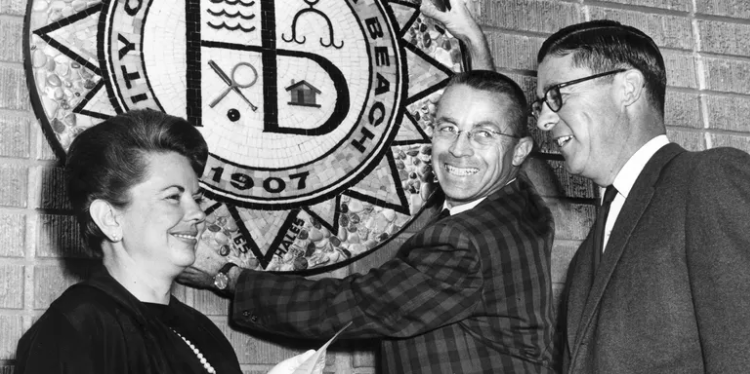
John T. Hales (click to read more)
The official seal of the City of Hermosa Beach was designed by graphic designer John T Hales, and adopted by the city in September 1965. Hales painstakingly pieced together the seal together with his son Donald and wife, Lorraine. The seal ingredients included 3,000 pieces of Italian tile with beach pebbles and shells. Sharing his appreciation was Quentin "Boots" Thelen then Mayor of Hermosa Beach.
QUICK LINKS
For more information on the Hermosa Beach Kiwanis Club and membership, call (310) 990-0673
RELATED CONTENT
 Hermosa Review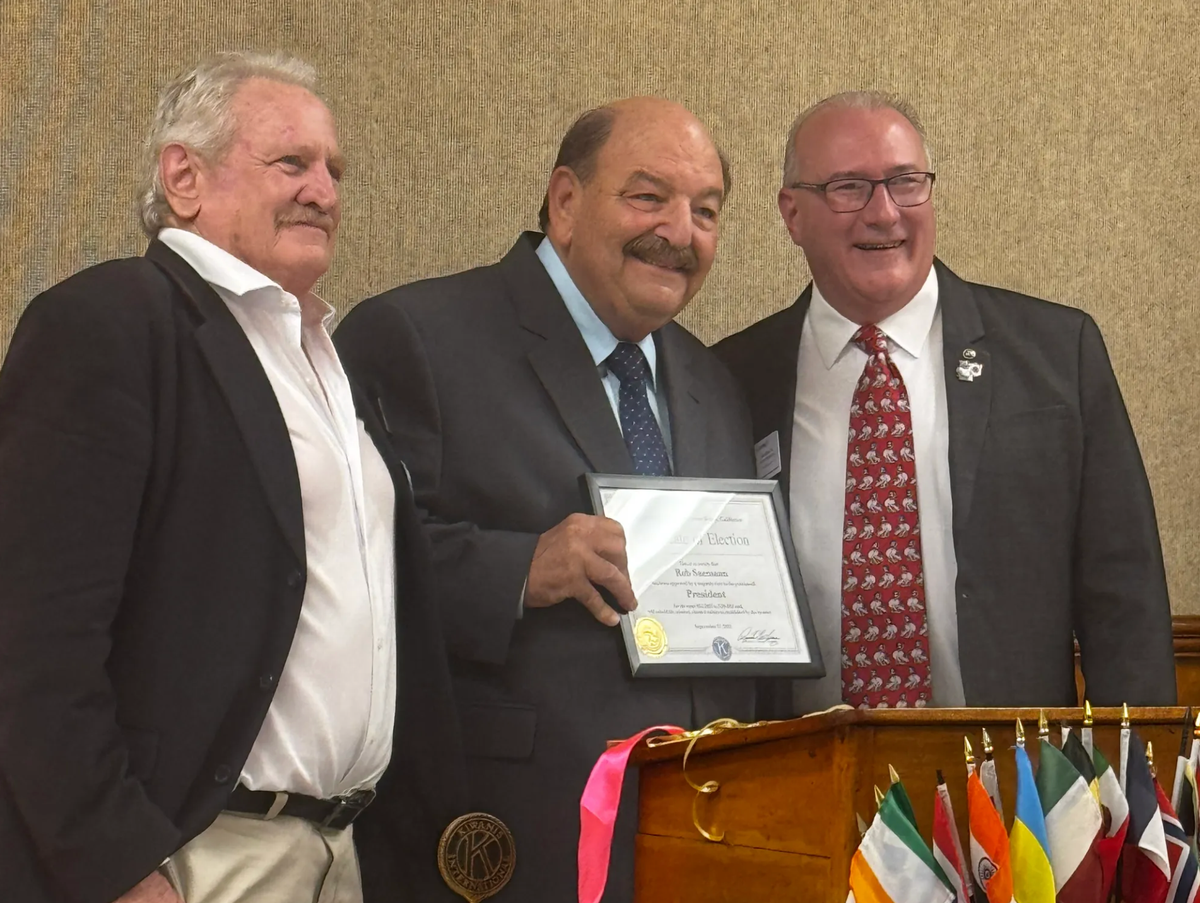
 Hermosa Review
 Hermosa Review
Read next

Patio Fee Debate Postponed as Business Owners Plead Their Case
Decision postponed on patio encroachment fees as residents urge support for iconic Hermosa businesses

A Rare Gem
As Scott Bilowit finally prepares to retire after 45 years behind the counter at Seymour Jewelers, Elka Worner looks at the history of his family business and finds out what comes next.


Valerie's Story
From Survival to Service: One Woman's Journey Through Homelessness. A Harbor Interfaith outreach worker shares her story of childhood homelessness, addiction, and transformation.

Hermosa Beach Resident Tom Horton to Receive ALS Commitment to Cures Award
Hermosa resident honored for ALS advocacy following mother's death, friend's battle with disease