

CRIME TIME : February 1st-7th
A busy week for Hermosa Beach PD with multiple drug arrests, several assaults, ongoing e-bike thefts, and the usual parade of public intoxication incidents around Pier Plaza.
Forthcoming mayoral rotation seems set to be overshadowed by personal disagreements and tensions that have boiled over in recent weeks.

Every nine and a half months, Hermosa Beach's five council members go through a ritual that is equal parts ceremony, tradition, and - on occasion - political theater. The outgoing mayor hands over the gavel. The Mayor Pro Tem steps up. A new Mayor Pro Tem is nominated. In theory, it's a collegial formality. In practice, it has sometimes been anything but.
On February 24, Mayor Rob Saemann's term will end and current Mayor Pro Tem Mike Detoy is expected to be nominated as Mayor. No one on the current council has signaled any objection, and the rotation would follow the pattern the council has maintained since a bitter battle involving former councilmember Hany Fangary that resulted in a lawsuit.
The real question is who gets nominated as Mayor Pro Tem - putting them next in line for the gavel roughly nine months later.
The current council consists of Saemann, Detoy, Francois, Jackson, and Keegan. Saemann and Detoy will have served their turns. Dean Francois already served as Mayor from July 2024 to April 2025. That leaves Ray Jackson and Michael Keegan as the two members who haven't held the position during the current rotation cycle.
Jackson has been on the council continuously since his May 2021 special election win and served as Mayor during 2023. Keegan won his seat in November 2024, though he previously served two terms from 2001 to 2009, including two stints as Mayor in 2003 and 2007.
Under the old system - the informal, decades-long tradition of rotating based on seniority and election vote tallies - the answer might have been straightforward. But that system no longer exists.
In October 2020, the council adopted Resolution 20-7265, a document born directly from the bitter controversy over Councilmember Hany Fangary being passed over for Mayor Pro Tem in November 2019.
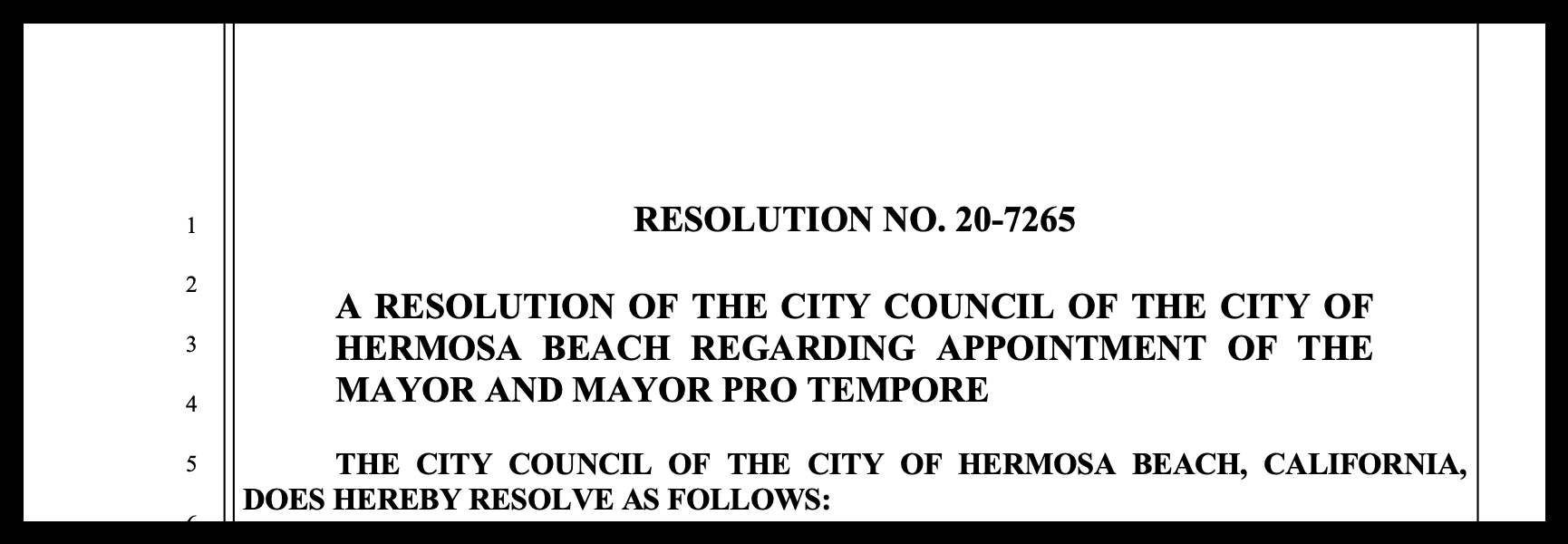
The resolution is explicit: it "rescinds, replaces and supersedes any and all previous practices and policies, written or unwritten" regarding mayoral selection. Gone is the old seniority-and-vote-tally formula. In its place is a set of discretionary criteria the council "may" consider - not "shall," not "must," but "may."
Those criteria include giving priority to a member who has not previously served as Mayor, and thereafter to the member with the longest continuous service since last serving. The resolution also states that the person selected should be able to "preside over City Council meetings" and "work effectively with City staff" - language widely understood as a codification of the rationale used to justify skipping Fangary.
The resolution passed 4-0 with Fangary abstaining. It was adopted via teleconference during the pandemic, with the Fangary lawsuit still pending.
If the council follows the resolution's discretionary guidelines, the analysis gets interesting.
Section 4(4) says priority "may be given to a member who has not previously served as mayor." Both Jackson and Keegan have served as Mayor - Jackson during the current cycle, Keegan way back in 2007. The resolution also suggests the council may consider "the member with the longest continuous service since last serving as mayor pro tempore and mayor." By that measure, Jackson's continuous service since his 2021 election is longer than Keegan's current stint, which began when he returned to the council in December 2024. But this language might also be construed to effectively exclude Keegan's earlier service, given the eighteen year interval between his last stint as Mayor and today.
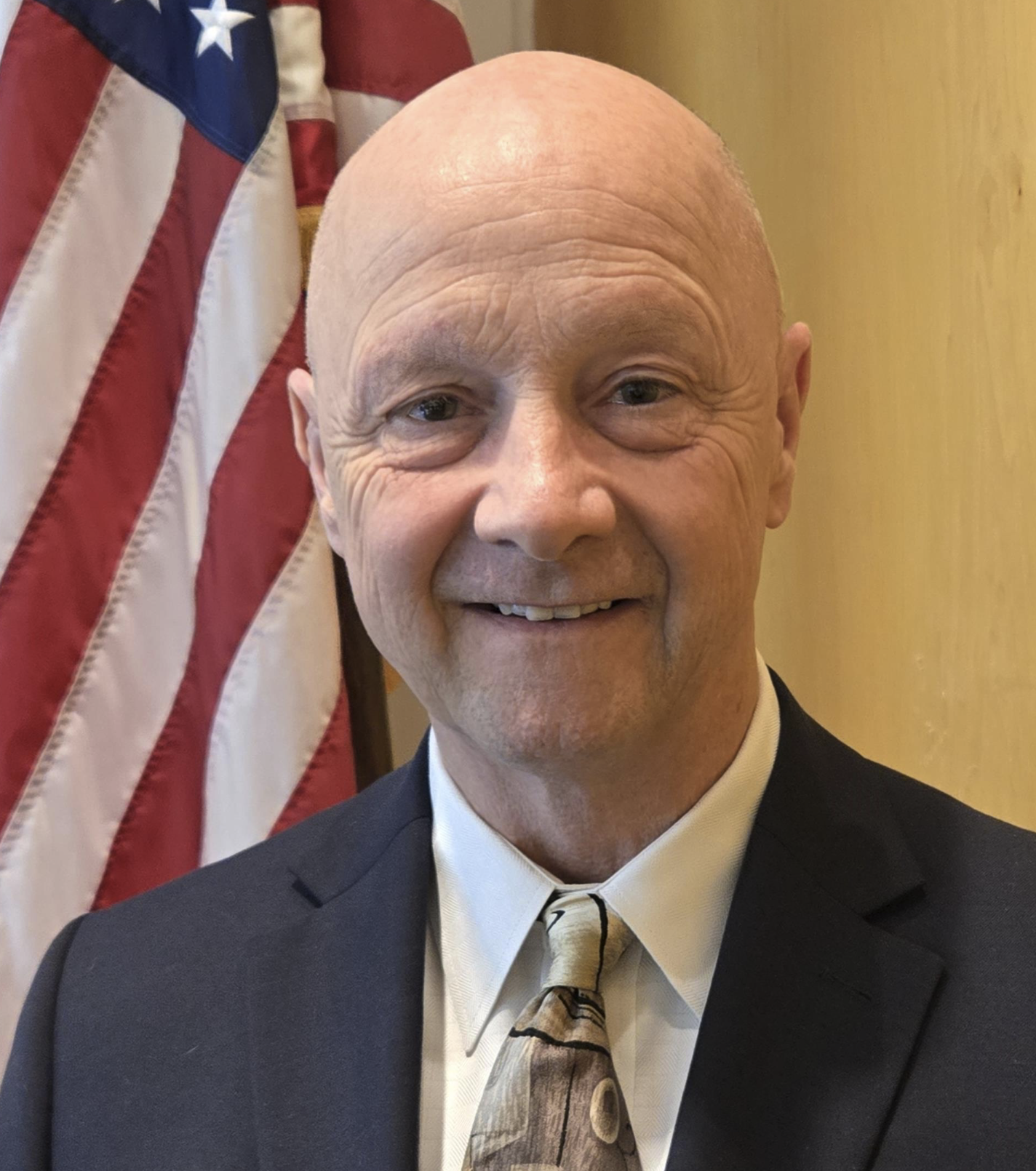
But every criterion in Section 4 is discretionary. None are binding, none take precedence over the others. They are all simply factors the council may weigh - or ignore. The council could consider working relationships, policy alignment, availability, or simply preference, and still be acting within the resolution's framework.
In another twist to the story, Jackson actually became Mayor Pro Tem for the first time in November 2021. He was nominated by former Councilmember Stacy Armato, who gave up her own customary turn in the rotation to allow Jackson in. This event ignored the guideline that the council had adopted the previous year which recommended that any Mayor/Pro Tem should have served a minimum of twelve months on council first. Jackson had served only seven at that point. So yes, the guidelines are completely discretionary.
Under the old guidelines of vote tallying, Keegan has a clear edge over Jackson. He won 4,373 votes in the 2024 election. Jackson won 3,572 votes in 2022 and just 1,576 in the special election of 2021.
For decades, the mayoral rotation was genuinely ceremonial. Council members took their turn, colleagues voted unanimously, photos were taken, and everyone went home. Michael Keegan, speaking at the July 2024 rotation as a private citizen, put it simply: "We have a rotational, ceremonial Mayor. It's worked fine for decades. It's not a popularity contest."
That began to change in November 2019. Councilmember Hany Fangary arrived at City Hall expecting to be named Mayor Pro Tem. Instead, incoming Mayor Mary Campbell nominated Justin Massey, citing Fangary's refusal to communicate directly with City Manager Suja Lowenthal. What followed was one of the most acrimonious episodes in recent Hermosa Beach politics. Fangary's wife filed a lawsuit, claiming illegal collusion in the decision by at least three other councilmembers. The city ultimately prevailed in court in March 2024, but the damage was done. Fangary was passed over again in 2020, resigned on Christmas Eve that year, and moved to Manhattan Beach, saying he'd been "slapped in the face" by colleagues he'd considered friends.
Since then, the rotation has carried a charge it never used to. In October 2023, when Jackson's mayoral term ended, he nominated Rob Saemann for Mayor Pro Tem instead of Dean Francois, arguing the process should be treated as "an election, not a rotation." The council rejected his alternative 3-2 and stuck with tradition, approving Francois on a 4-1 vote with Jackson the lone dissenter. In July 2024, when Francois rose to Mayor, it was preceded by public comments from a handful of residents alleging personal misconduct. Jackson again cast the sole no vote against Francois.
What was once a rubber stamp has become, in recent cycles, a moment where political tensions surface publicly.
There is a certain irony in Raymond Jackson's position in all of this. Jackson won his council seat in May 2021 in the special election called specifically to fill the vacancy created by Fangary's resignation - the same resignation triggered by Fangary being passed over in the rotation. Dean Francois, now a fellow councilmember, was among the four other candidates Jackson defeated in that race.
Jackson arrived on a council still dealing with the fallout of the Fangary affair. Resolution 20-7265, which formalized the discretionary criteria for selecting the Mayor and Mayor Pro Tem, had been adopted just seven months before Jackson was sworn in. The resolution was designed to prevent another Fangary-style controversy by giving the council clear legal standing to exercise judgment rather than follow a rigid rotation.
And yet Jackson has been the council member most willing to use that discretion - voting against the rotation in both 2023 and 2024, arguing each time that the process is an election, not an entitlement. He now finds himself on the other side of that question. The resolution born from the controversy that created his council seat is the same framework that will determine whether he gets the nod on February 24.
Any discussion of the Mayor Pro Tem selection has to grapple with what has happened on the Hermosa Beach City Council since the November 2024 election - because the atmosphere has been poisonous.
The arrival of Michael Keegan, who campaigned on a promise of "course correction," shifted the council's balance of power. The most visible consequence was the departure of City Manager Suja Lowenthal, who resigned in May 2025 after two marathon closed-session performance reviews totaling more than five hours. Lowenthal had enjoyed majority council support since her hiring in 2018, but the election of Keegan - and what appeared to be a shift by Saemann - left her without it. Jackson, who had been one of Lowenthal's strongest defenders, was furious.
The council then hired Steve Napolitano, the former Manhattan Beach mayor and councilmember, as interim and then permanent city manager. Jackson voted against Napolitano's appointment at every stage - as interim in May 2025 (a 3-2 vote, with Detoy also opposed), and as permanent city manager in December (4-1, with Jackson the lone dissenter). Jackson's objections were partly procedural (he argued Napolitano was never properly interviewed or vetted), and partly emotive. At the December meeting, he noted that Lowenthal's compensation had been "considered too much money" while comparable pay for "the less qualified guy" was apparently acceptable.
But the tension has gone well beyond policy disagreements. There are repeated reports that Jackson refuses to speak to or shake the hand of either Francois or Keegan, and barely communicates with Saemann or City Manager Napolitano. He has publicly and repeatedly criticized Francois, Keegan, and Saemann for their roles in Lowenthal's departure, and Napolitano for putting himself forward for the interim position without going through a competitive process. More recently, Keegan has reported that Jackson called him "a racist prick" and referred to Keegan and Napolitano as "butt buddies."
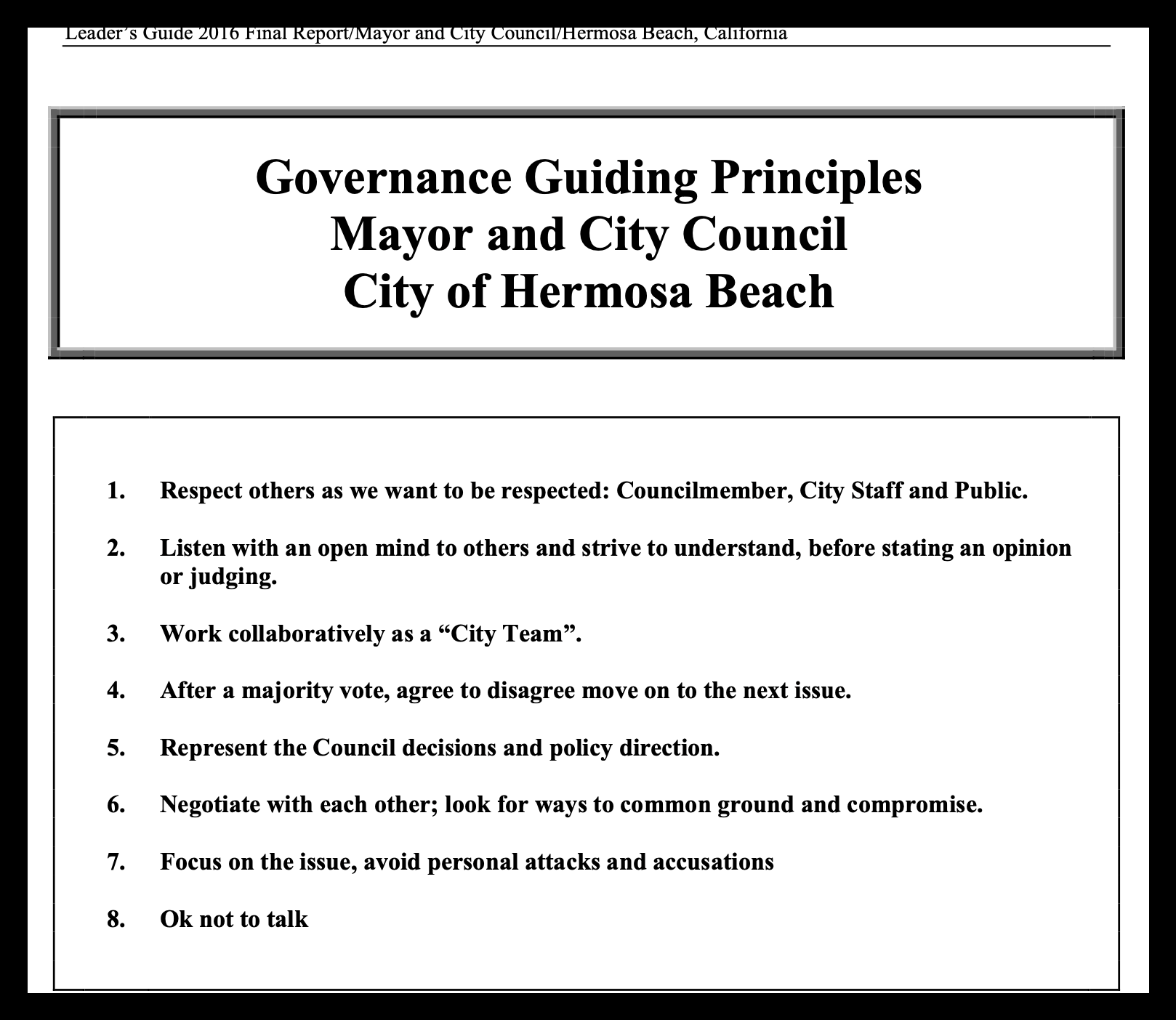
The behavior is impossible to ignore in the context of the Mayor Pro Tem selection - not least because of the Fangary precedent. Fangary was skipped for Mayor Pro Tem in 2019 specifically because he refused to communicate with the city manager. Resolution 20-7265, adopted in the aftermath of that controversy, explicitly lists the ability to "work effectively with City staff" as a criterion for the Mayor and Mayor Pro Tem. If Jackson is refusing to engage with the city manager, three of his four council colleagues, and is using the kind of language Keegan has described, his colleagues would have both precedent and a textual basis in the resolution for passing him over - just as Fangary was passed over before him.
The parallel is almost too neat: Jackson sits in the seat Fangary vacated, governed by the resolution Fangary's skipping produced, and now faces the same question Fangary faced - whether his colleagues believe he can "work effectively" with the people he needs to work with.
Jackson's frustration with his council colleagues has not been confined to City Hall.
In recent weeks, Mayor Saemann replaced Jackson as Hermosa Beach's delegate to the South Bay Cities Council of Governments (SBCCOG), the regional joint powers authority that coordinates transportation funding, homelessness programs, climate initiatives, and major grants across 16 South Bay cities. Jackson had served as Hermosa's representative for three years, rising to Second Vice Chair of the organization.
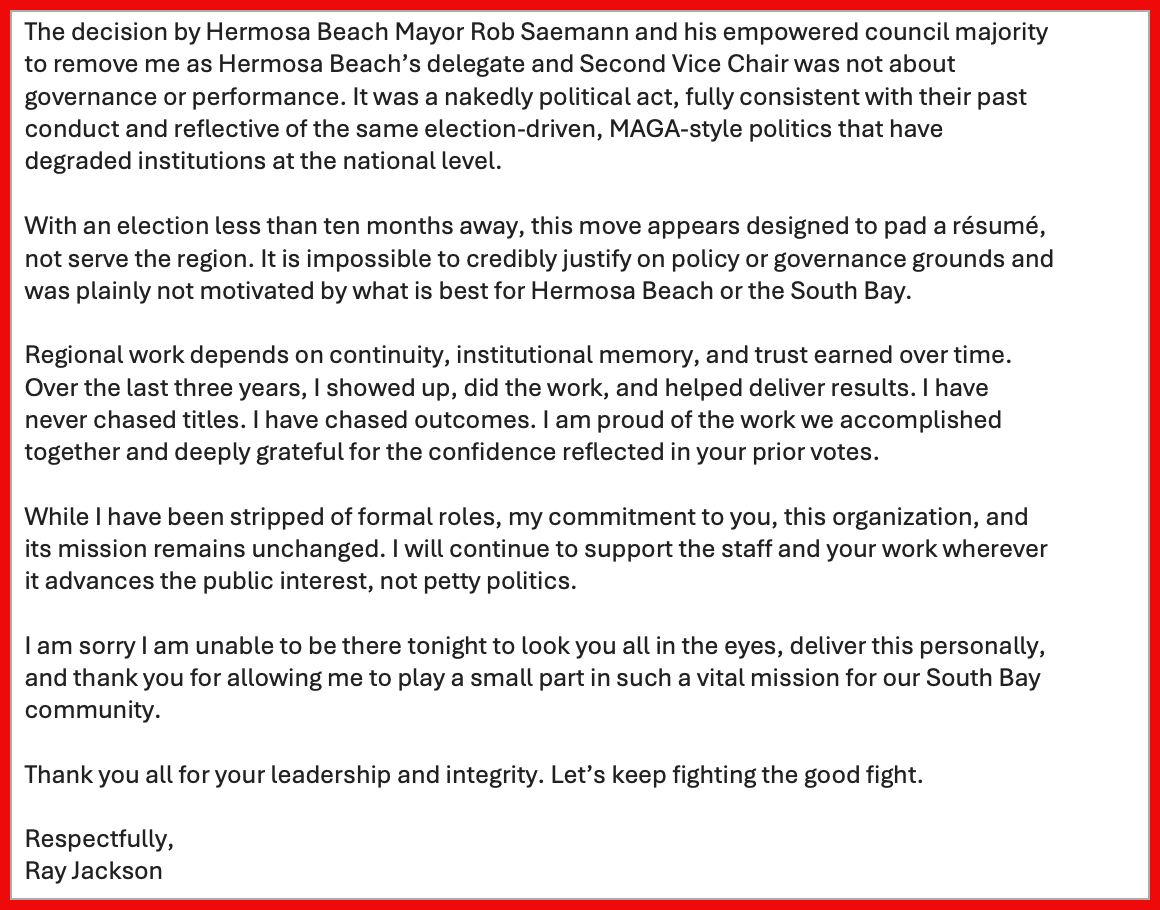
Jackson did not go quietly. In an email obtained by The Hermosa Review under a public records request, Jackson wrote to all SBCCOG board members describing his removal in inflammatory terms. Unable to attend the SBCCOG meeting in person because he was traveling to San Francisco for an emergency Coastal Commission meeting, Jackson asked that his statement be read into the record.
"The decision by Hermosa Beach Mayor Rob Saemann and his empowered council majority to remove me as Hermosa Beach's delegate and Second Vice Chair was not about governance or performance," Jackson wrote. "It was a nakedly political act, fully consistent with their past conduct and reflective of the same election-driven, MAGA-style politics that have degraded institutions at the national level."
Jackson characterized the move as résumé-padding by Saemann ahead of the November election - an accusation that carries a certain irony given the questions about Jackson's own interest in carrying the Mayor Pro Tem title into his re-election campaign.
"With an election less than ten months away, this move appears designed to pad a résumé, not serve the region," Jackson wrote. "It is impossible to credibly justify on policy or governance grounds and was plainly not motivated by what is best for Hermosa Beach or the South Bay."
Jackson's critics say that his outburst is "sulking" and "sour grapes".
The email also contained language that sits uneasily alongside Jackson's likely grab for the Mayor Pro Tem title. "I have never chased titles," Jackson wrote. "I have chased outcomes."
One former Hermosa Beach mayor laughed when presented with that quote last week. "Jackson is all about titles. That's part of the problem here. His ego is getting in the way of just getting on with business. And all this stuff about racism and misogyny - it's crap. You can't keep going around throwing this stuff out there every time you lose a vote. We used to disagree about all kinds of stuff in my time, but we never carried on like that."
The SBCCOG email is notable for several reasons. It was sent to elected officials from across the South Bay, airing Hermosa Beach's internal political disputes before a regional audience. The "MAGA-style politics" characterization - in a nominally nonpartisan small-city context - is the kind of language that escalates rather than resolves conflict. And Jackson's inability to attend the SBCCOG meeting in person because of a Coastal Commission scheduling conflict underscores the availability questions that surround his candidacy for Mayor Pro Tem.
That availability issue deserves its own examination. In May 2025, Jackson was appointed by the Senate Rules Committee to the California Coastal Commission, filling the South Coast seat for a four-year term running through 2029. It is a significant appointment - the Commission oversees development along all 840 miles of California's coastline - and Jackson has described it as 'challenging' work.
But it comes with a significant time commitment. The Coastal Commission meets monthly for three-day sessions, typically Wednesday through Friday. Since his appointment, Jackson has been absent in person from multiple City Council meetings due to scheduling conflicts with Commission business.
That matters in this context because Resolution 20-7265's criteria for the Mayor and Mayor Pro Tem include the ability to "preside over City Council meetings." The Mayor Pro Tem's primary formal duty is to step in when the Mayor cannot attend. If the Mayor Pro Tem himself is regularly unavailable due to an outside commitment, the position's core function is undermined. And if Jackson were to advance to Mayor - as the Mayor Pro Tem traditionally does - it could become even more significant.
Jackson's colleagues may view his Coastal Commission service as commendable public service. They may also view it as a reason to question whether he can fulfill the duties of either role.
This November, three council seats are on the ballot. The terms of Francois, Jackson, and Saemann all expire. All three men have indicated to friends that they intend to run for re-election.
That adds another dimension to the Mayor Pro Tem question. The title may be largely ceremonial in terms of governing authority, but it carries symbolic weight. A council member running for re-election as Mayor Pro Tem has a built-in advantage: name recognition, a title that signals leadership, and the appearance of being next in line for the top seat. In our local elections, where small margins and name familiarity can make the difference, that kind of edge matters.
If Jackson secures the Mayor Pro Tem designation on February 24, he would carry the title straight through the November campaign. Depending on the timing of the next rotation, he would be in line for the mayorship itself around the time voters head to the polls.
Whether his colleagues see a reason to hand him that advantage - given the current state of relations on the dais, the practical question of his availability, and the tone of his recent public communications - is another question entirely. And whether Jackson, who has repeatedly argued that the rotation should be treated as an election rather than an entitlement, would find it awkward to now claim it's automatically his turn - that's worth watching too.
The February 24 meeting will test whether this council can find a way through. The dynamics are complicated: Jackson's seniority argues for his selection, but his behavior, his availability, his own stated philosophy about the rotation being merit-based, and his public characterization of his colleagues in the SBCCOG email could all be used against him. Keegan is the newest member of the current council, but he is no political novice - he served two terms and held the mayoralty during his previous stint from 2001 to 2009. More to the point, he has working relationships with the city manager and his colleagues that Jackson currently does not - and he doesn't have a three-day-a-month scheduling conflict.
There is also the question of whether anyone (incoming Mayor Detoy ?) tries to broker a quiet resolution before the meeting - or whether the nomination plays out live, as it has in some of Hermosa's more dramatic recent rotations.
One former Hermosa Beach Mayor gave a fairly blunt assessment this week. "We never struggled with this rotation thing back in my time. We didn't always agree on every item, but the rotation was simple. The old council should never have started this mess with Hany, and Jackson shouldn't have carried on the way he did with Francois. Now he will have to suck it up."
 Hermosa Review
 Hermosa Review
 Hermosa Review

A commissioner resigned. A neighbor locked the gates. Tennis balls with hostile messages were lobbed at a nearby house. And now, after an $826,000 renovation, Hermosa Beach is ready to do it all again.

Nike wants to run 10,000 women through Hermosa Beach on a Saturday night in October. The Parks Commission said...not so fast.

A complaint about cracked pavement led to the quiet removal of Clark Field's basketball hoops. The neighborhood's response was not so quiet.

Nike's global women's night race series wants to run 10,000 runners through Hermosa Beach. The city has to figure out whether the event is worthy of the disruption to residents and businesses.
By Hermosa, for Hermosa. Join The Review today.