A commissioner resigned. A neighbor locked the gates. Tennis balls with hostile messages were lobbed at a nearby house. And now, after an $826,000 renovation, Hermosa Beach is ready to do it all again.
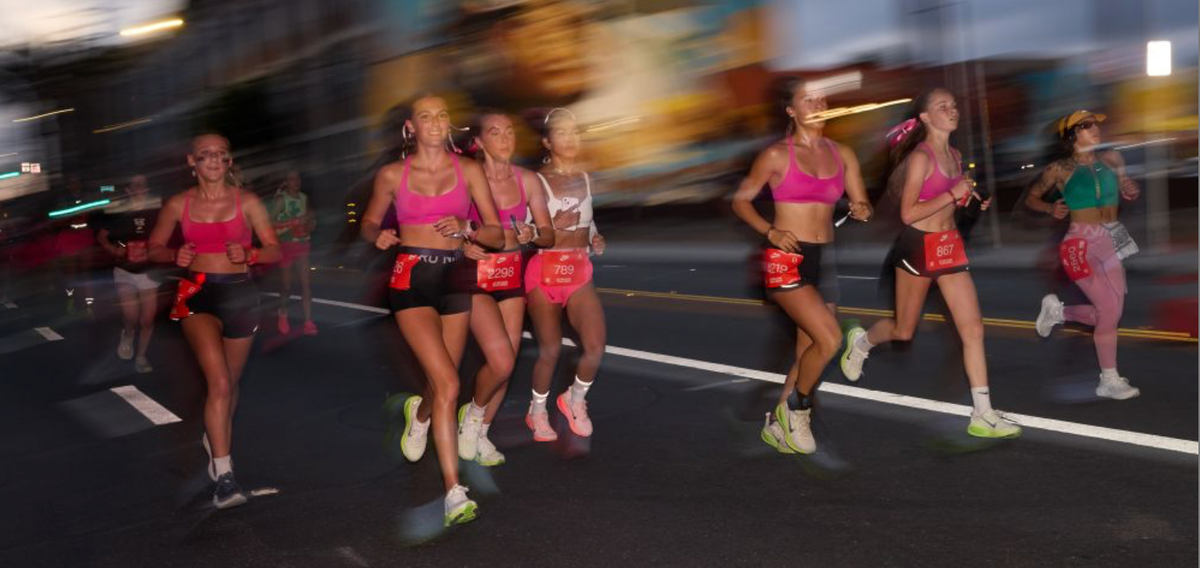
A global women's night race series wants to run 10,000 runners through Hermosa Beach. After a divided Parks Commission hearing, it's now up to City Council to decide.
The Parks and Recreation Advisory Commission voted 3-2 on Monday night to forward the Nike After Dark Tour LA 2026 to City Council for a public hearing — but pointedly declined to recommend approval of the event, which would bring an estimated 10,000 to 12,000 runners through Hermosa Beach on a Saturday evening in October.
The event, classified as Impact Level III — the city's highest impact designation for special events — would close Hermosa Avenue, the Strand, and several side streets on October 17 as part of a global women's night race series spanning eight cities worldwide. City Council is expected to hear the item on March 10.
Hermosa Beach would be a pass-through. The 13.1-mile course starts and finishes in Redondo Beach, with runners heading north through Hermosa before looping back.
Late Changes
Several details shifted between the staff report and Monday's hearing. Nike experience producer Jake Wanamaker told the commission that the event producers have dropped Manhattan Beach from the course entirely, eliminated a previously planned Friday setup day, and reduced the expected field from 15,000 runners (last year's LA race) to 10,000–12,000.
Staff also recommended that a section of the route originally crossing into Manhattan Beach on Manhattan Avenue be rerouted to stay within Hermosa. Nike said they were open to the change.
The race start time is now confirmed at 5:00 p.m., timed to catch the October sunset as runners finish along the coast.
What Would Close, and When
Road closures on the Hermosa Beach portion of the course have been updated from the original staff report. Based on Nike's presentation Monday night:
Herondo Street (westbound lanes): hard closure from 4:30–10:00 p.m. Hermosa Avenue, Herondo to 34th Street (northbound lanes): hard closure from 4:30–10:00 p.m. Hermosa Avenue, 22nd Street north: closure from approximately 5:00 p.m. The Strand: closure from 5:00–11:00 p.m.
Closures for 34th Street, Manhattan Avenue, and 35th Street listed in the original staff report are now on hold pending the route revision that would keep runners out of Manhattan Beach.
Runners would use the northbound lanes of Hermosa Avenue — a staff-recommended change from the original plan to keep the southbound lanes open for access to parking lots, downtown businesses, and emergency vehicles.
Nike's race director, Jim Heim, said the actual period of hard closure in residential areas would be approximately 90 minutes, with soft closures and rolling openings before and after. Wanamaker acknowledged the Strand closure would be longer — potentially from 5:30 p.m. to as late as 10:30 p.m. — since it covers the final miles of the course.
Staff says the actual period when runners are passing through Hermosa would last approximately 50 minutes, during which hard closures would be in effect. Before and after that window, closures would be "soft" — allowing some vehicle and pedestrian movement.
The Commission's Concerns
The hearing revealed a commission sharply divided over whether the event's benefits justified its footprint.
Commissioner Tom Moroney was the most direct in his opposition. "I'm just stunned that an event this size can get this far, and this is the first time I have heard of it," he said. "We did do a Parks Master Plan. 70% of the people said that we have enough events in town. There's just no way I would do this."
Commissioner Elka Worner shared those concerns, questioning what Hermosa gains from an event that starts and ends in Redondo Beach. "You're essentially shutting down the city for businesses and for residents," she said. She noted the event would fall on the same weekend as the Skechers Pier-to-Pier Friendship Walk and AAU volleyball, and that the Parks Master Plan indicated residents were satisfied with the current event calendar.
Chair Barbara Ellman said her biggest worry was the lack of public participation. "This is the Kids' Choice Awards on steroids," she said, referencing the ill-fated event from 2019 that caused widespread disruption to local businesses. "We just can't have this big an event" without broader community input. She called the event "possibly a Pandora's box" for which the commission did not have enough information.
Commissioner Todd Tullis was the most sympathetic, noting that Level 3 event days have actually declined — from 56 in 2024 to a projected 50 in 2026, not counting this event. He acknowledged concerns about the cost-benefit balance but said he was "more on the optimistic end," pointing to the likelihood that 10,000 visiting runners would fill hotels and restaurants the night before and after the race.
Vice Chair Traci Horowitz also saw potential, comparing the closures to those during Fiesta Hermosa and the triathlon. "Streets are closed during Fiesta for three days, and businesses sometimes complain," she said. But she acknowledged "a lot of unknowns on how the logistics would play out."
Public Comment
Public comment was thin — only four speakers — which itself became part of the debate. Several commissioners attributed the low turnout to residents being largely unaware the event was under consideration.
Resident Tony Higgins argued the event offers little benefit to residents and questioned whether staff had tracked the hundreds of hours already spent on planning. David Grethen questioned what Hermosa gets from opening up "its public right of way so this event can happen."
Laura Peña, identifying herself as both a resident and business advocate, offered the most detailed critique. She urged the commission to attach conditions if it moved forward: guaranteed on-course activations in Hermosa's commercial areas, a coordinated marketing plan directing runners into local businesses, formal merchant outreach before final route approval, and a post-event economic impact summary. "Visibility alone is not economic vitality," she said.
What Hermosa Beach Gets
The event is estimated to generate around $16,500 in permit fees for the city, covering the application fee, category fees, setup/teardown, and amplified sound permits. That figure does not include parking revenue or potential co-sponsor fees.
Nike would be responsible for all indirect and direct costs associated with the event, including police, fire, and public works overtime on event days. However, staff confirmed that the hundreds of hours of planning time during normal business hours are not billed to event producers — for this or any other event. That time is covered by a $1,094 application fee.
Worner asked Nike directly whether the company — valued at $94 billion — would consider a donation to the city. Wanamaker said Nike's social and community impact team was open to conversations about community give-backs, particularly focused on youth sports.
Staff outlined additional community benefits Nike has offered: 100 complimentary race entries for Hermosa Beach residents, potential partnerships with the Valley School run club, and possible merchandise and equipment donations to youth sports programs.
How Many Events Is Enough?
Critics continue to point to the city's own 2024 Parks Master Plan — a document the city paid $329,000 to develop, backed by 1,123 pages of community survey data, and unanimously approved by City Council just over a year ago as a 30-year guiding document. A statistically valid community survey conducted as part of that plan found that over 70% of residents felt the city already had the right number of special events.
Hermosa Beach currently hosts 52 special events generating 144 total event days annually. Adding the Nike After Dark Tour — which would also require an exception to the city's own two-events-per-day policy for the Sunday teardown — raises the question of whether the calendar is creeping beyond what residents said they wanted, barely a year after the city asked them.
Tullis pushed back on that narrative with his own data, noting that Level 3 event days have decreased from 56 in 2024 to 53 in 2025 to a projected 50 in 2026. "To those residents who wanted fewer large events," he said, "we're not expanding the number of level three events."
Higgins, during public comment, was less convinced. "You approve three high-impact Level 3 events in the last two months — the LA Galaxy, the Labor Day Fiesta, and you're probably going to approve a Nike Half Marathon tonight," he said. "You're not taking away any events, and you're not listening to the findings of the master plan."
What's Next
The event will go before City Council on March 10 for a public hearing. The commission's motion carried 3-2, with Moroney and Worner voting against forwarding the item — they would have preferred to stop it at the commission level.
Horowitz recommended that staff make additional efforts to notify residents and businesses along the route before the council meeting, beyond the standard public hearing notices. Staff indicated they were receptive, with Senior Recreation Supervisor Brian Sousa suggesting mailers could go out in the intervening month.
Nike's broader timeline shows a global race announcement around March 1, early college registration opening April 15, general registration May 1, and a 14-week training program beginning July 11.
Neither Redondo Beach nor Torrance — the other two cities on the course — have yet taken the event to their commissions or councils. Staff said both cities are "in support" but are waiting to see what Hermosa does first.
A commissioner resigned. A neighbor locked the gates. Tennis balls with hostile messages were lobbed at a nearby house. And now, after an $826,000 renovation, Hermosa Beach is ready to do it all again.
Nike's global women's night race series wants to run 10,000 runners through Hermosa Beach. The city has to figure out whether the event is worthy of the disruption to residents and businesses.