A commissioner resigned. A neighbor locked the gates. Tennis balls with hostile messages were lobbed at a nearby house. And now, after an $826,000 renovation, Hermosa Beach is ready to do it all again.
A commissioner resigned. A neighbor locked the gates. Tennis balls with hostile messages were lobbed at a nearby house. And now, after an $826,000 renovation, Hermosa Beach is ready to do it all again.
In which Hermosa Beach reopens four pickleball courts and pretends everything will be fine this time.
The Kelly Courts pickleball renovation is approaching completion. New surfaces. New fencing — ten feet tall now, because six wasn't enough to stop the climbers. New gates. New separation between the tennis and pickleball courts.
What hasn't changed is the argument.
On Monday night, staff presented the Parks and Recreation Advisory Commission with two options for the reopened courts. Option 1: add Sundays. Option 2: go full seven-days-a-week, nine-to-nine.
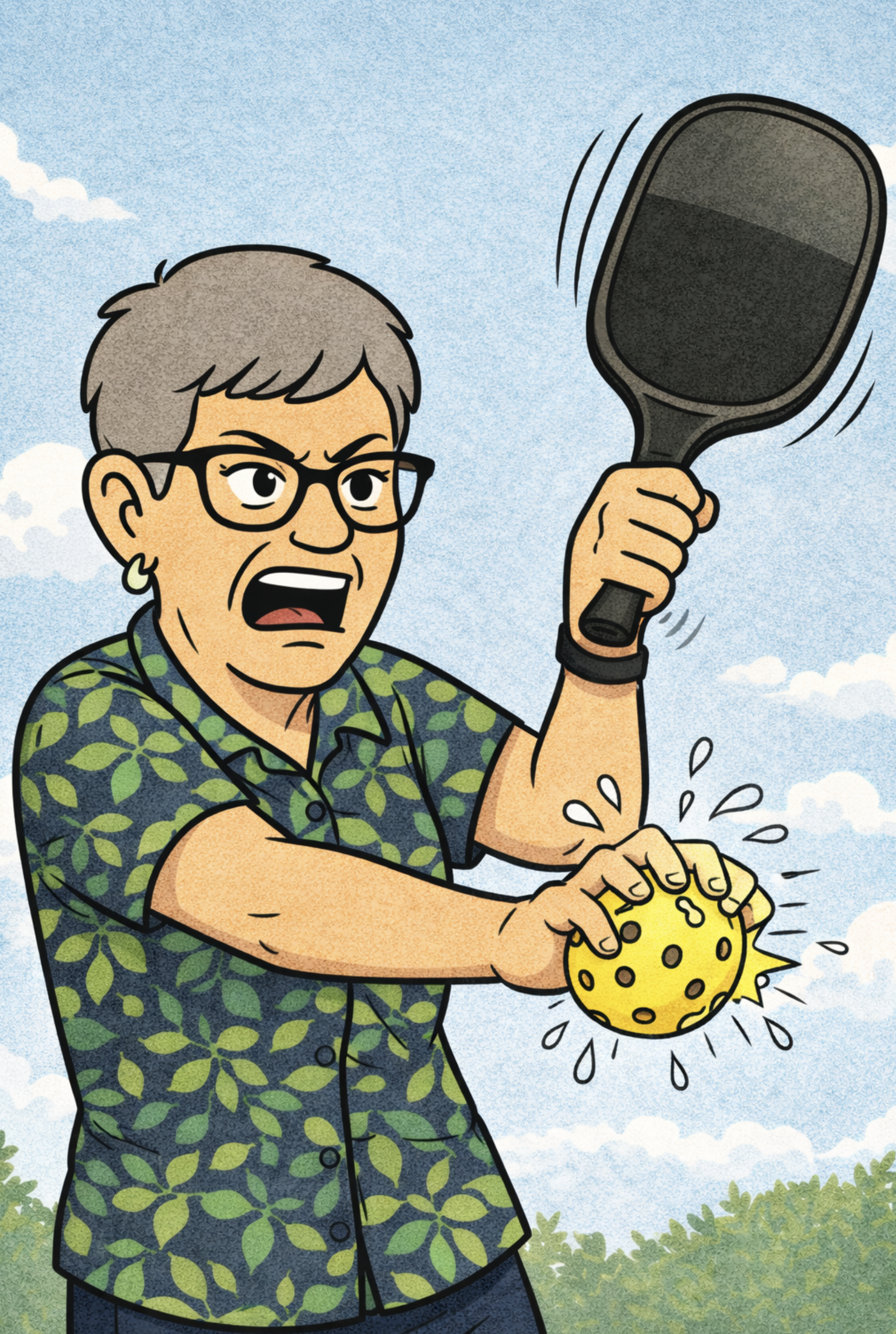
Chair Barbara Ellman, who has spent eight years - yes, eight years - mediating the pickleball wars, launched into a retrospective of her bruising pickleball journey with the intensity of a Ken Burns documentary and the neutrality of a plaintiff's attorney.
"I am so offended that this has come back the way it has," she said.
For those keeping score at home, the original pickleball policy was forged through months of negotiation involving a stakeholder focus group, a subcommittee, multiple commission hearings, and what can only be described as a community-wide emotional reckoning. The process apparently produced a commissioner resignation, a physical altercation at the courts, a neighbor who locked the gates so no one could leave, and — in a detail that really captures the spirit of the thing — tennis balls with hostile messages lobbed onto a nearby resident's property.
Then the city got sued. Two courts were closed. Then all four were closed for the renovation. And for two blissful years, an uneasy peace settled over the immediate neighborhood.
Now staff wants to talk about expanded hours.
Ellman responded in much the same way as someone who has just realized that their new tattoo contains a spelling mistake. A mixture of shock and fury, and a hint of desperation.
"We said when we closed those courts that we would reopen with the original program," she reminded the room.
Staff had prepared a thorough presentation. Memberships are up. Every neighboring city operates seven days a week. Pickleball is the fastest-growing sport in America, most notably among the 25-to-34 demographic, which is a fancy way of saying it has escaped the retirement community and is coming for the rest of us.
None of this moved the chair.
"If people would play with the foam ball," Ellman said, "you could play pickleball from six o'clock in the morning till midnight and nobody would care."
This is the holy grail of Hermosa pickleball policy — the foam ball. It is quieter. It performs the same. And absolutely no one will use it voluntarily.
Commissioner Todd Tullis, himself an active player, confirmed that quiet paddles are "much quieter" and perform identically. He did not volunteer to lead the enforcement effort.
Staff noted that requiring quiet equipment would need someone physically on site to check paddles, which would require additional staffing, which would increase the general fund budget, which would require a longer conversation with city management. In other words: we are not doing that.
Commissioner Moroney floated the idea of making it self-policing. Staff responded with what might be the most diplomatically devastating sentence of the evening: "I think we all can be honest with the approach of how self-policing works."
Meanwhile, resident Gail Rose, who lives on 11th Street behind the courts, delivered remarks that could reasonably be classified as a hostage statement.
"If it goes from nine to nine, you might as well put a gun to my head," she said. She described years of noise reverberating into her backyard and invited any commissioner to come sit there during play. She noted that the neighbors who used to complain alongside her have moved away — one to Manhattan Beach, which, for a Hermosa resident, is the municipal equivalent of witness protection.
On the other side, resident Geraldine said she drives to another city almost every day just to play pickleball because she can't get court time in Hermosa. "I just want to play pickleball here in Hermosa Beach," she said, a sentence she has apparently delivered at three separate commission meetings over the years.
Ana Garcia, who lives on Bard Street directly above the courts, said she didn't renew her membership for 2026 because of the construction, but called getting a court reservation in Hermosa "an act of God."
The written public comments ran 27-to-1 (or 40-to-1, depending on who was counting) in favor of expanded hours. Ellman was unmoved. "They have nothing to compare it to," she said of the commenters, most of whom have not lived through the Great Pickleball Unpleasantness of 2017–2021.
The commission voted 4-1 to recommend keeping the original program: closed Sundays and Mondays, evening play only Tuesdays and Thursdays, and a 120-day evaluation period after the courts reopen.
Staff accepted the recommendation with the quiet professionalism of people who had prepared two detailed options and a comparable cities analysis and were now being told to just do what they were already doing.
The courts are expected to reopen in late March. The 10-foot fencing is made of material that is, in staff's words, "very, very difficult to climb."
They'll need it.
City Hall Sketch is a satirical look at the ins and outs of our local government. The Hermosa Review will check back in 120 days to see how this one is going. We already have a good idea.
Nike's global women's night race series wants to run 10,000 runners through Hermosa Beach. The city has to figure out whether the event is worthy of the disruption to residents and businesses.