

City Council Eases Land Value Recapture Fees, Aims to Spur Downtown Development
Council supports Planning Commission decision to backtrack on 'failed experiment'
Council supports Planning Commission decision to backtrack on 'failed experiment'

In a 4-1 vote Tuesday night, the Hermosa Beach City Council approved Planning Commission recommendations to significantly reduce Land Value Recapture (LVR) fees for small mixed use development by commercial property owners, with supporters hoping the change will finally unlock stalled downtown construction.
The council voted (in line with a Planning Commission recommendation) to eliminate LVR fees entirely for properties with maximum density of one to two units and reduce fees from $76 to $40 per square foot for three to four-unit developments. The changes take effect 30 days after adoption.
A substitute motion by Councilmember Michael Keegan to eliminate fees for properties up to six units failed 2-3, with only Councilmember Dean Francois joining in support.
Councilmember Raymond Jackson cast the lone dissenting vote on the approved measure, arguing that relaxing LVR requirements undermines the city's affordable housing mandate. Jackson had previously stated in October 2023 when the scheme was first proposed "I don't want money, I'm not a fan of the fee...I want affordable housing...I don't want to incentivize market rate development."
Jackson also raised the specter of "land banking," suggesting property owners might hold parcels indefinitely without building if fees were eliminated. But as Planning Manager Alexis Oropesa confirmed, "there is nothing to prevent someone from holding on to the property" even with LVR fees in place.
Critics of LVR argued that it may in fact encourage land banking by making immediate development unprofitable while preserving the theoretical future value of the upzoning.
Upper Pier Ave. property owner Jon David, who has warned about LVR since 2022, was blunt: "It is just a program that programmatically makes small infill housing in Hermosa Beach infeasible on our commercial lots... You can't capture any value if you don't create that value."
He noted the program "blocks protected housing 10 units and under" and warned of potential legal jeopardy: "We have proven mathematically that it blocks housing, protected housing. And so I think... we have to be careful also of following the law, of having HCD come to us and say we mathematically proved our study proved that we're blocking housing, blocking protected housing. And why didn't you fix it?"
Hermosa's 'Housing Element', a part of the city's General Plan that aims to satisfy state mandates on 'affordable' housing provision has come under increasing scrutiny after a recent appeal court decision in neighboring Redondo Beach which ruled that part of their plan was infeasible.
The vote marked a significant retreat from the city's ambitious 2022 affordable housing strategy. Mayor Rob Saemann, who had previously supported the program, acknowledged it as "a failed experiment."
"I honestly, I think that being able to change your mind as a planning commissioner or councilman or mayor... is a plus not a minus," Saman said. "I think it's a plus to be able to reevaluate something, a decision you made once, to reevaluate it and say the world changes, the situation changes."
The program, incorporated into the city's 2021-2029 housing element, was supposedly designed to capture value from commercial properties rezoned to allow residential development. The fees were intended to either incentivize developers to include affordable units or generate revenue for a housing trust fund.
To date, the program has produced zero affordable housing units and zero revenue, according to Community Development Director Alison Becker.
"I recommend that we be... gingerly handling the request from the council to consider changes to the land value recapture program," Becker told councilmembers. "We're mid-cycle. We will be beginning our process to develop our next cycle housing element within two years."
However, Becker acknowledged reality: "If we are really not seeing... revenues which can help us subsidize or otherwise support affordable housing production, we can design a new program."
The council could revisit the entire LVR program structure for the next housing element cycle and potentially eliminate it for larger projects as well if the pattern of zero results continues.
One public commenter wryly observed: "There is affordable housing in Hermosa Beach. I know this because I took advantage of it... in my 20s. It was called having roommates."
 Hermosa Review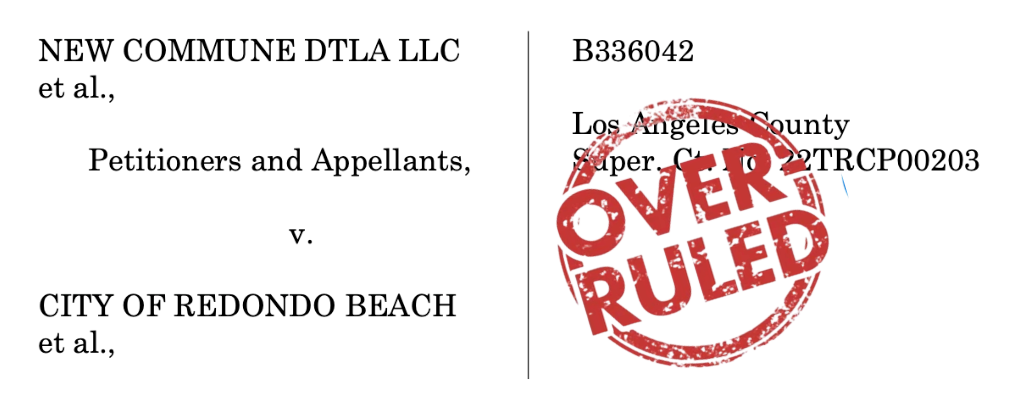
 Hermosa Review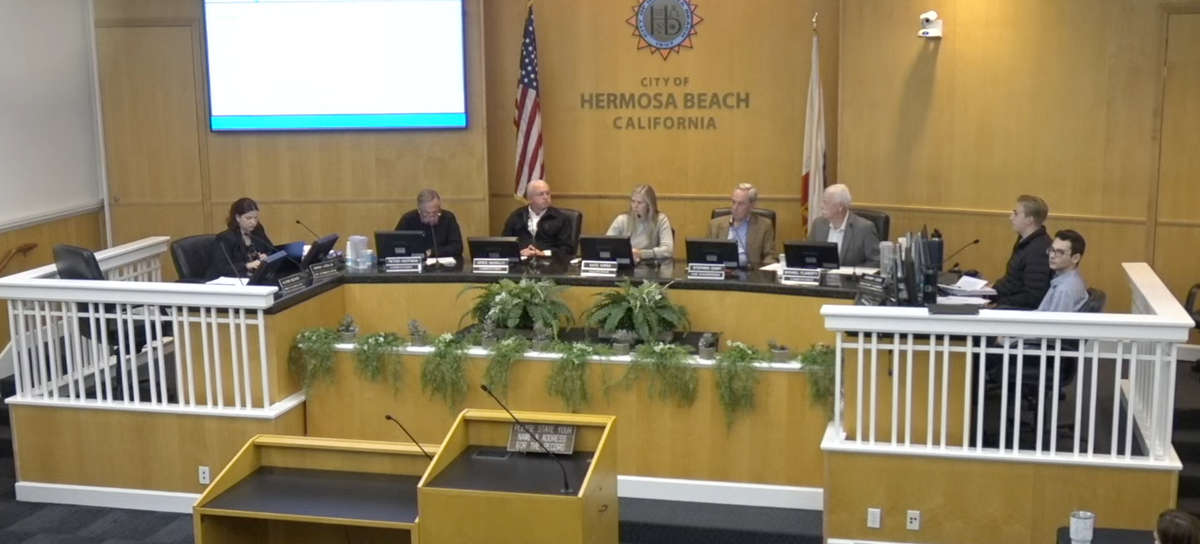

Decision postponed on patio encroachment fees as residents urge support for iconic Hermosa businesses

Homeless update, Outdoor seating fees and controversial developer fee program all on the agenda, together with beach vendor proposals

Mayor follows up his recent State of the City event with a wide-ranging Q&A discussion

By Hermosa, for Hermosa. Join The Review today.